Research prototype · Team capstone
Cat_framework — Hazus seismic bridge-loss pipeline
Problem
Catastrophe loss models are usually opaque; a loss number without an inspectable validation chain cannot be trusted or taught from. The goal was an open seismic bridge-loss pipeline following FEMA Hazus 6.1 end to end.
Why it matters
Loss estimates drive insurance and infrastructure decisions, and they are only as good as their validation. An honest pipeline shows where the recipe fails, not only where it works.
Approach
My role
Team-built capstone with two collaborators; presented as team work, with no individual claim made beyond team membership.
Method
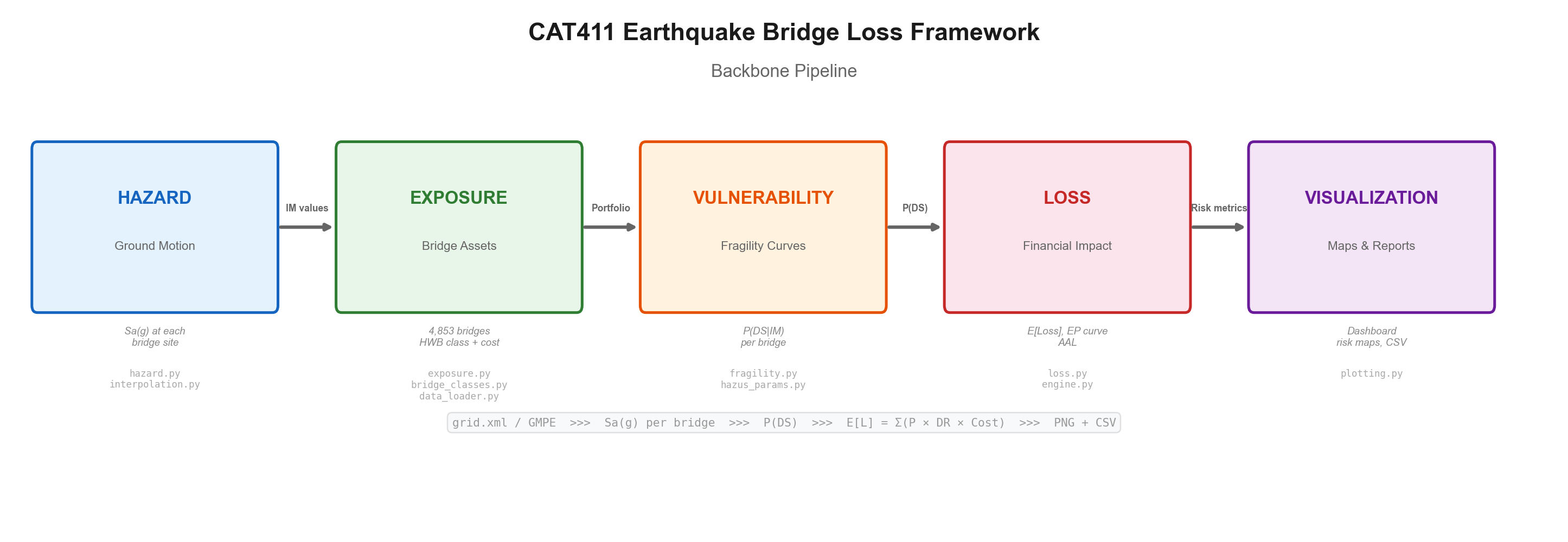
Hazard (ShakeMap/GMPE) → exposure (national bridge inventory) → fragility (Hazus 6.1) → loss, exceedance-probability, and average-annual-loss layers, with recalibration against observed data.
What was built
A typed, layered Python pipeline implementing Hazus fragility mechanics, ground-motion modeling cross-checked against an independent implementation, and an EP/AAL finance layer.
Key challenge
Validating a national-recipe model against a real event. The pipeline is validated at three levels against the 1994 Northridge earthquake, and the failures are reported as findings — the baseline recipe's over-prediction is stated, not smoothed over.
Validation & limitations
The three-level Northridge validation with honestly reported failures is the centerpiece; recalibration is statistical, with uncertainty reported.
Results & status
Research prototype — team capstone; no releases.
Links
Transferable relevance
Academic Catastrophe-modeling literacy grounding the Lehigh Center for Catastrophe Modeling and Resilience affiliation.
Industry The catastrophe-risk industry's native language — Hazus, fragility functions, exceedance-probability curves — plus model-validation practice with failures disclosed.