Maintained open-source tool
research-hub — an AI-operable research workspace
Problem
A literature workflow is spread across Zotero (references), Obsidian (notes), and NotebookLM (briefs), and moving papers between them by hand is repetitive, error-prone, and impossible for an AI assistant to drive reliably.
Why it matters
Researchers lose hours to manual copying between tools, and an AI assistant can only help if the whole workflow is exposed through a stable, scriptable interface rather than a pile of one-off clicks.
Approach
My role
Sole designer and maintainer, end to end — architecture, the CLI, the MCP server, the REST API and dashboard, CI design, the evaluation suite, and the release process.
Method
One AI-operable workspace over all three tools: search papers across arXiv, Semantic Scholar, PubMed, and CrossRef; ingest them into Zotero; sync notes to Obsidian; and verify NotebookLM briefs against their sources — each step available from a CLI, an MCP server, and a REST API so an agent can run the whole pipeline.
What was built
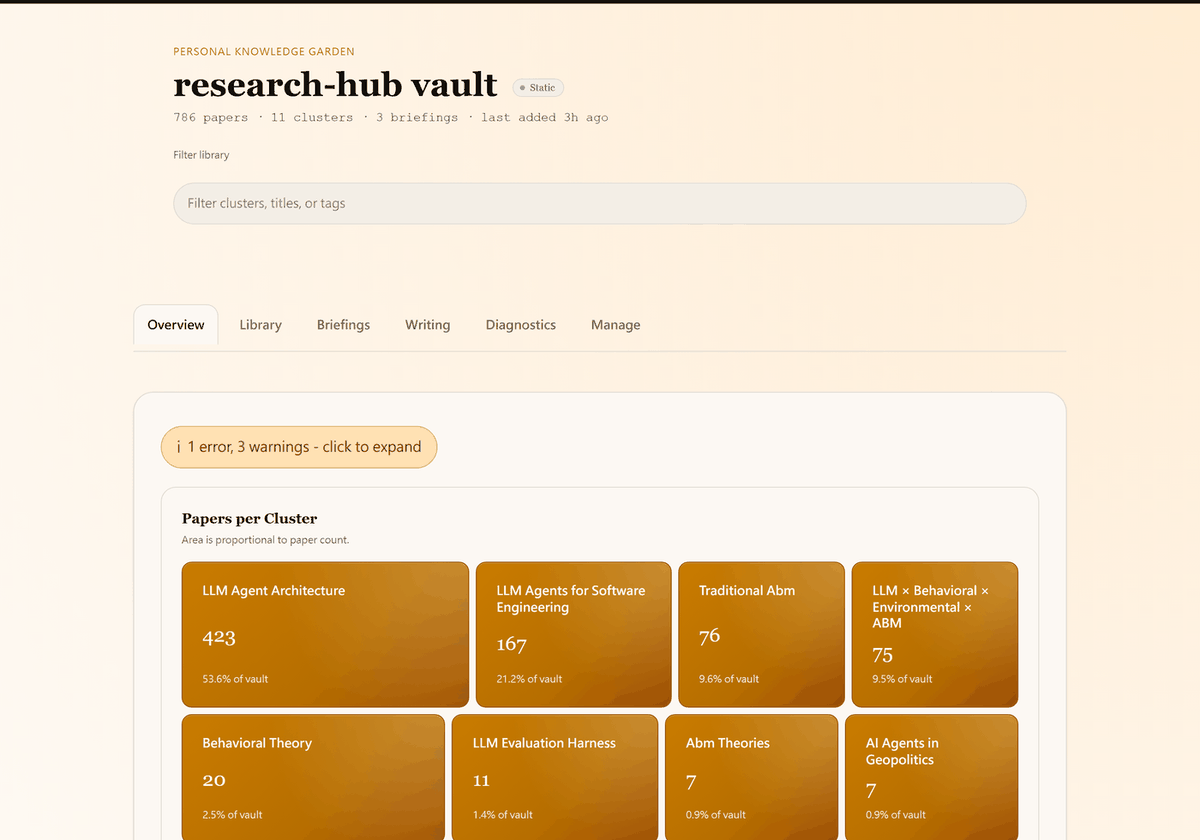
A Python package published to PyPI as research-hub-pipeline v1.1.1 (MIT), exposing a CLI, an MCP server (listed in the Awesome MCP Servers catalog), a REST API, and a dashboard. All three external tools are optional — start with any two.
Key challenge
Making three independent tools behave as one reliable, repeatable pipeline across operating systems — and keeping retrieval quality honest, which is why the repo ships an automated test suite for retrieval quality and records observed failures rather than hiding them.
Validation & limitations
Tested on Windows, macOS, and Linux; an automated test suite checks retrieval quality. The README states honestly that the tool is in daily use by one researcher tracking 7+ research clusters — the limitation is disclosed, not hidden.
Results & status
Maintained open-source tool; v1.1.1 live on PyPI with a documented release history.
Links
- PyPI: research-hub-pipeline
- GitHub repository
- Cross-platform CI workflow
- Retrieval quality tests
- Changelog
Transferable relevance
Academic Reproducibility infrastructure — a scriptable, testable spine under an everyday literature workflow.
Industry A published MCP server with a CLI, REST API, and CI matrix — directly legible for AI-tooling, agent-infrastructure, and research-engineering roles, with third-party recognition (Awesome MCP Servers).