Research & Academic Work
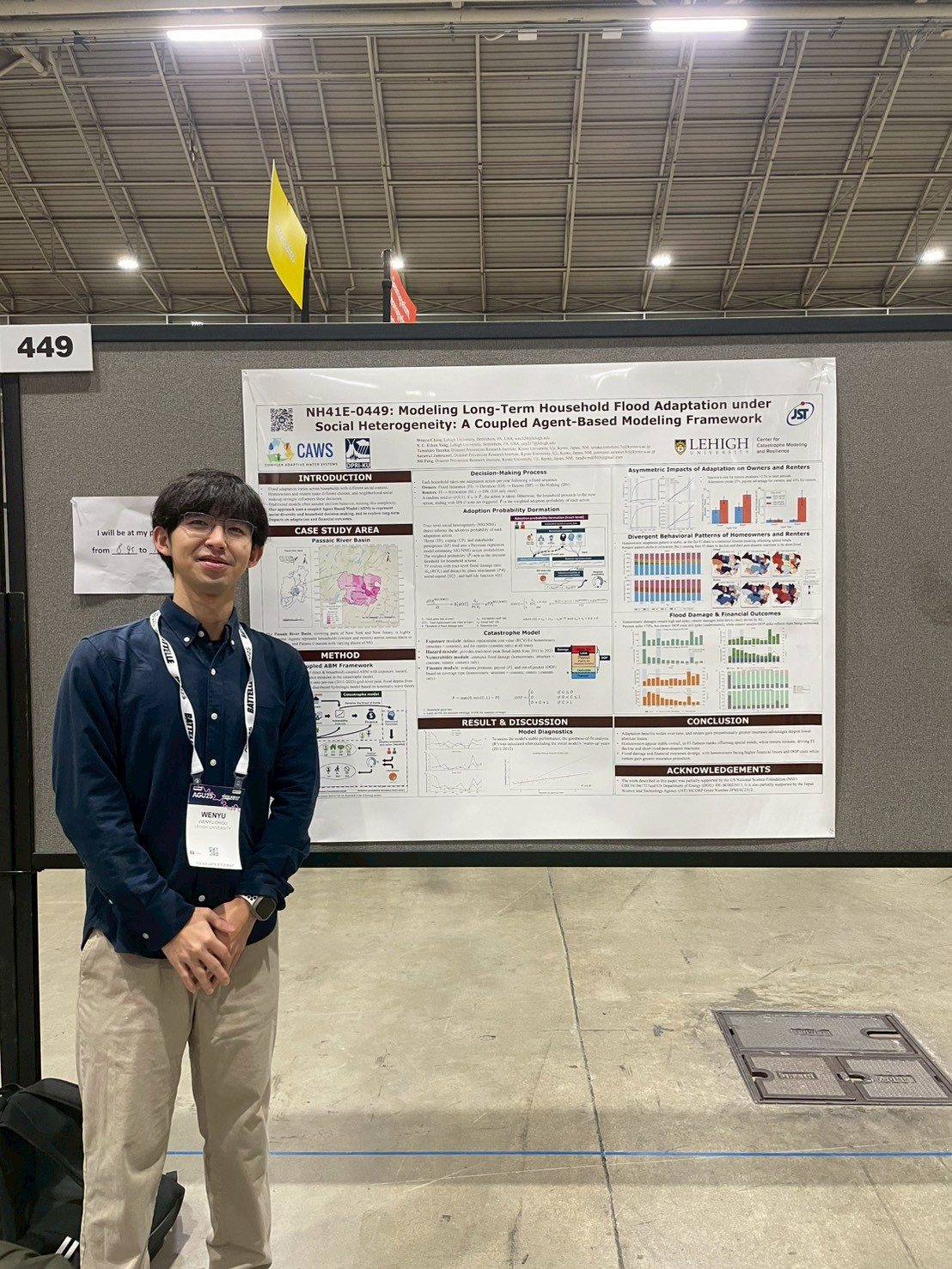
My research asks a question generative AI has made urgent: when can a simulated human decision-maker be trusted? I approach it by connecting each stage of the research process. I designed and fielded a 937-household flood-adaptation survey in New Jersey’s Passaic River Basin, used structural equation modeling to identify how owners and renters actually decide among adaptation actions, and encoded those empirically identified pathways in a Bayesian-calibrated agent-based model of 52,141 households coupled to a catastrophe flood model with National Flood Insurance Program mechanics — including income-normalized equity analysis of who bears flood losses. With my advisor, I published a Water Resources Research article (62(6), e2025WR042111, 2026) substituting large language models as the behavioral engine of such simulations. That substitution creates a validity problem: nothing guarantees a generative agent decides the way real households do. My current work addresses it directly through an LLM evaluation study that compares human survey pathways with label-blind synthetic personas across social groups, alongside governance methods that constrain agent behavior with physical constraints and behavioral theory. The household flood-adaptation and financial-outcomes study is under revision following peer review at Water Resources Research; the social-group LLM study is in preparation for planned submission to Progress in Disaster Science. The longer-term agenda is a governance standard for generative agents in consequential simulation.
The research program, as one arc
Survey
Designed and fielded a 937-household flood-adaptation survey (557 owners / 379 renters) in New Jersey’s Passaic River Basin.
Methods / source Calibration files in the FLOODABM repository; the empirical grounding of the Water Resources Research paper.
Instrument feeding one published article and manuscripts now under review.
Decision pathways (SEM)
Identified flood-adaptation decision pathways through structural equation modeling — across owner and renter groups, and across marginalized and non-marginalized groups (the equity strand).
Methods / source Flood Adaptation Decision Variables and Pathways across Social Groups: A Comparison between Human Survey Responses and Responses Generated by Large Language Models. Planned submission to Progress in Disaster Science.
In preparation; the redesigned elicitation and study protocol are being validated.
Coupled ABM–CAT model
Built a Bayesian-calibrated agent-based model of 52,141 households across 27 census tracts, coupled to a catastrophe flood model with National Flood Insurance Program premium, payout, and deductible mechanics and income-normalized equity analysis of who bears flood losses.
Methods / source Household Flood Adaptation and Financial Outcomes: A Coupled Human–Flood Modeling Analysis of Homeowners and Renters. Water Resources Research.
Code: Research prototype, archived. Paper: Under revision following peer review.
LLMs as the behavioral engine
Applied large language models as the behavioral engine of an agent-based model of a human–water system — the core contribution. Because nothing guarantees a generative agent decides the way real households do, the work also checks LLM personas against empirically identified human decision pathways.
Methods / source Yang, Y. C. E., & Chiou, W. (2026). Leveraging Large Language Models for Agent-Based Simulation of Human–Water System Interactions. Water Resources Research, 62(6), e2025WR042111.
Published.
Governance methods
Validation architecture for generative agents — hard physical and financial constraints plus behavioral-theory coherence, fail-closed, with audit trails — generalized beyond the flood domain.
Methods / source Research software in preparation for release; public echoes in the fail-closed design of the open-source tooling.
In preparation.