Skip to content

Stage 7.5 — Advanced Agentic Concepts Map

繁體中文 | 简体中文 | English

Estimated Time: 1 week (about 5 hours — no coding, just reading resources to build the concept map)

🚪 Entry condition: complete Stage 7 — Multi-Agent · Productionization (or at least Stages 4 + 6 + 7). This chapter is a frontier concept map for after productionization, not an intro — without having built a production agent you will not feel what pain points these concepts solve.

💡 This is an advanced-concept map + reading path, not a full tutorial. After Stages 4 / 6 / 7, you can already build production agents (AI systems that plan + execute tasks autonomously — LLM-based programs that drive their own actions; "production agents" are agents that real users can rely on without frequent breakdowns); this stage helps you locate which advanced concepts are still being debated in the industry, what problem each concept solves, and which papers / blogs to read first, so you do not step into problems that others have already hit in real work.

📋 Chapter Structure (8 sections, read in order):

  1. Why this stage exists (positioning)
  2. Concept-map spine: the Types → Config → Repo → Service four-layer work boundary
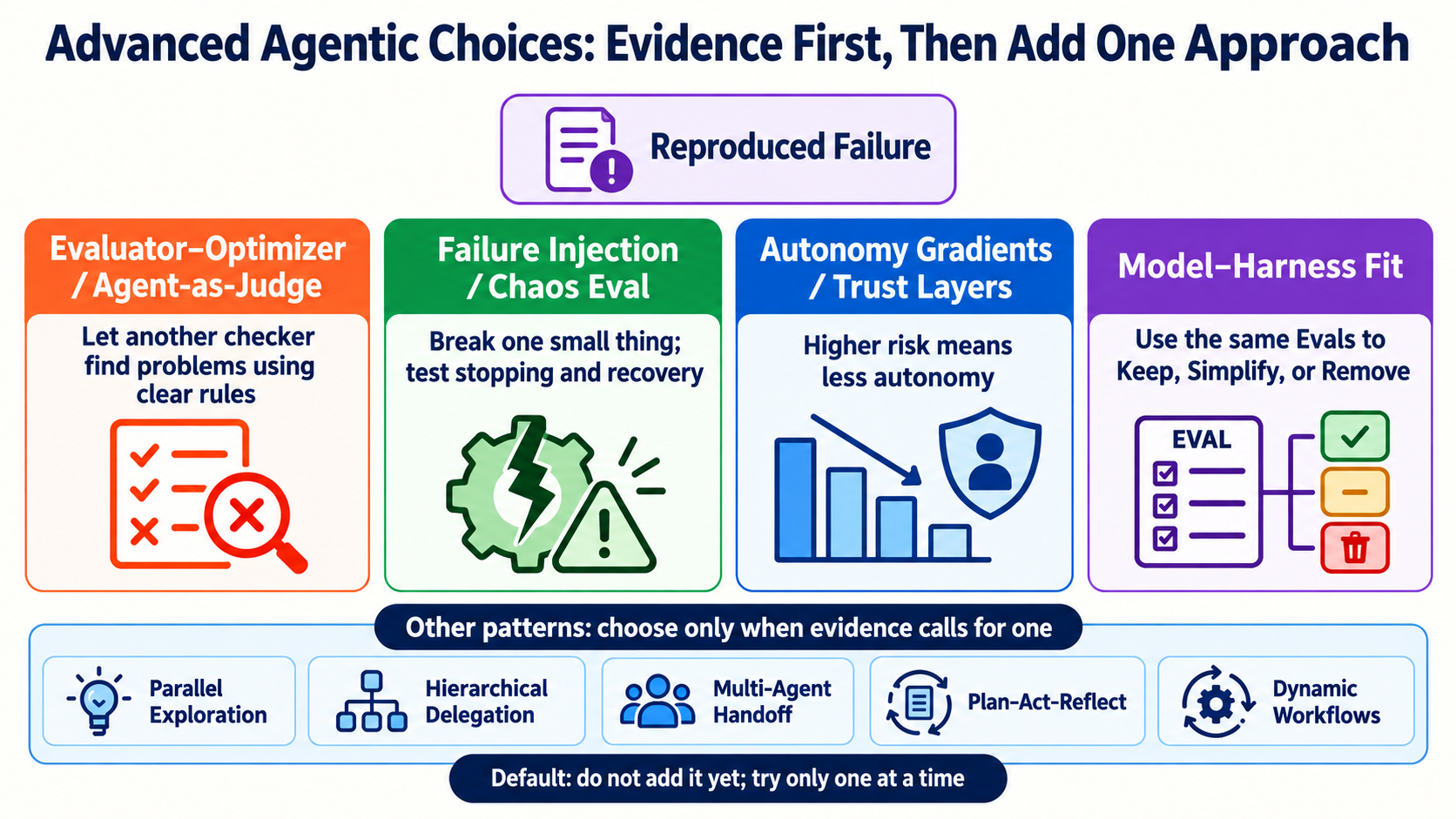
  3. 12 advanced concept skeletons
  4. Why these 12 were chosen
  5. Cross-concept Harness Engineering Principles (4 categories + dependency map)
  6. Advanced agentic application flow (5 steps)
  7. Complete reading path
  8. Self-check

🔤 Quick abbreviation reference (these recur throughout the chapter):

Abbreviation Full form One-line meaning
agent AI autonomous executor An LLM-based system that plans + executes tasks on its own
PR Pull Request A request to merge a change into the main branch (GitHub term)
SoR System of Record The authoritative source of truth for knowledge
ACI Agent-Computer Interface The interface layer between an agent and the system (tools / APIs / docs)
MCP Model Context Protocol A spec for standardizing agent tools
PAR Plan-Act-Reflect A single-agent self-loop pattern (plan → act → reflect → revise → retry)
CI Continuous Integration The system that auto-runs tests / linters on every commit
QA Quality Assurance Quality gatekeeping (human or automated)
lint / linter A tool that auto-scans code for rule violations
[OAI] / [Anth] OpenAI / Anthropic Source tags used later in the chapter

🎯 Why this stage exists

Stages 4 / 6 / 7 together cover 70% of production-grade agents (agents real users can rely on without frequent breakdowns). What each stage teaches and what you can do after:

Stage Teaches What you can do
4 Choosing a framework (which tool to build agents with) Pick LangGraph / AutoGen / DSPy and build an agent
6 Context engineering (dynamically managing what you feed the agent) memory / retrieval / prompt assembly
7 Harness engineering (the reliable runtime environment around an agent) observability / retry / cost gates / eval / sandbox — the 8 components
7.5 (this chapter) The advanced-concept map Know which paper to open when problems appear / see what someone else's agent is actually doing / map each concept to a layer of the agent system

But frontier AI labs (Anthropic / OpenAI / Cognition / Microsoft) + academia (Stanford / CMU / Princeton) have continued publishing 12+ advanced design concepts from 2024 to 2026. Some you won't use yet, but you need to know they exist — so that when a problem shows up later, you know there is a ready-made pattern to borrow. This stage is not another theory chapter; it is a map:

  • It is not asking you to master all of them
  • It is not asking you to use all of them
  • It helps you know which paper / blog to open when a problem appears
  • It helps you see what someone else's agent is actually doing — e.g., when their agent hits an error, is it just "retry N times then give up" (= retry only), or "after an error, think a round, fix the approach, then try again" (= the plan-act-reflect loop pattern)? Those are entirely different design grades. Being able to tell them apart is how you decide whether to copy their approach
  • It helps you know which part of the agent system each concept maps to, and which kind of problem it solves

🧭 Concept-map spine: the four-layer work boundary

This stage uses the work boundary as the spine for organizing advanced agentic workflows: split an agent system into 4 layers (Types → Config → Repo → Service, expanded below), then ask "which layer is the agent operating on, and what breaks when it crosses a layer?" This is not collapsing the entire chapter into a single model — it gives the reader a coordinate system first, so the 12 concepts that follow can all be placed on the same map and compared.

💡 What "stack" means: software engineering convention splits a system into top-to-bottom layers, each layer doing one job, upper layers sitting on top of lower ones — collectively called a stack. A common web app is a 3-layer stack: frontend → backend → database. This stage splits an agent system into 4 layers (Types / Config / Repo / Service) and asks which layer the agent should be touching.

⚠️ These 4 layers are different from the Stage 7 prompt → context → harness layers. They are two different views: - Prompt → Context → Harness (Stage 7): stack position — are you engineering the string, the information, or the surrounding runtime? - Types → Config → Repo → Service (this stage): scope of autonomy — how deep into the stack can the agent act? Is crossing layers a violation?

The two views are orthogonal and solve different problems. After this section, you should be able to look at agent systems through both lenses at the same time.

Borrow software architecture layering — Types → Config → Repo → Service — and apply it to agent systems:

Agentic Stack 4-Layer Work Boundary

→ Every layer boundary is a work boundary. The scope the agent operates on = the scope of its autonomy:

  • Agent at Types layer = can only fit an existing contract, cannot change the schema (example: Codex receives a brief and adds inline glosses)
  • Agent at Config layer = can adjust budget / policy but cannot modify memory (example: a context-budget agent changes max_cost_usd)
  • Agent at Repo layer = can read and write memory / vector stores but cannot redesign the workflow
  • Agent at Service layer = can recompose the whole workflow; this is the highest autonomy

Why the work boundary fits as the spine

Many advanced concepts eventually trace back to the same question: how far does the agent's autonomy actually go? Think of an agent like a new intern: you give them a clear, narrow task, and they take it on themselves to touch nearby things too — that's a "work-boundary violation". The industry has 3 publicly-documented real cases that map onto this:

  • Didn't stop at the boundary (Cognition's Flappy Bird case): a multi-agent (multiple agents collaborating in parallel) system was tasked to build Flappy Bird. One sub-agent (a child agent spawned by the main agent to execute one sub-task) built the green pipes; another built the cloud background — and the two clashed visually because neither knew what the other was doing, i.e. neither had the other's context (the full set of information the agent receives). Cognition put it bluntly: "sub-agents are like a team of overconfident new hires — they won't ask the questions they should be asking." → Source: Cognition — Don't Build Multi-Agents (2025-06)

  • Added unrequested extras (Anthropic's "speculative leap" finding): a sub-agent assigned to research a topic would insert lines like "I also speculate that X might hold, though I haven't verified it" into the final report — unsolicited. Anthropic's multi-agent paper specifically discusses why this "helpful filling-in" needs to be engineered out, otherwise hallucinations smuggle themselves past the supervisor. → Source: Anthropic — How we built our multi-agent research system (2025-06)

  • Operator granted too much permission (Replit Agent 2024 prod-database incident): per community reporting, a user gave an agent direct production database access without a "destructive operations require confirmation" gate. While "fixing a bug" the agent ran a destructive SQL command that wiped production data. The agent followed instructions reasonably; the fault was the operator not setting boundaries. → Source: Simon Willison's analysis of the incident (2024) (community write-up, not an official Replit postmortem)

What these 3 cases tell you:

  • Agents do not "naturally stop at the point you assigned" — your brief must explicitly say "only touch X, do NOT touch Y", and sub-agents must receive the parent's full context.
  • Agents will proactively "fill in" things not requested — use structured output schemas + evaluator-optimizer loops to filter speculative content.
  • A rule "being installed ≠ being followed" — operator self-discipline is not enough. You need mechanical gates (permission check, cost cap, destructive-op confirmation) to prevent humans from bypassing the rule with "just this once".

How this maps to tools: write the work boundary into the brief (Anthropic's brief template / LangGraph state schemas / agent-collab-skills' task-splitter — all the same idea), enforce it at an acceptance gate / evaluator loop, and put an explicit gate in front of destructive operations (covered in §7 Autonomy Gradients).

🔁 Failure-mode lifecycle (how industry agent failures evolved into best practice)

Failure-Mode Evolution Cycle

Every industry-grade agent failure mode goes through the same loop: discover incident → publicly document → encode as a framework pattern → eliminate automatically. Five publicly documented cases:

# Incident (discovered) Documented name Codify (which pattern it became) Public source
1 Multi-agent subagent context drift (Flappy Bird style mismatch) "Sub-agents don't share principal-agent context" Single-thread principle: don't stack multi-agents — use linear orchestration Cognition 2025-06
2 Subagent speculative leap (unverified speculation smuggled into output) "Speculative hallucination via filling-in" Evaluator-optimizer loop: add a critique step that forces review Anthropic Multi-Agent Research 2025-06
3 Production permission drift (agent dropped prod DB) "Unbounded autonomy on destructive ops" Autonomy gradient: suggest / propose / execute tiered authorization Replit Agent 2024 incident
4 Agent looping without self-criticism (AutoGPT stuck loops) "Reflexion-less iteration" Plan-Act-Reflect loop: add self-critique + revise step Reflexion paper (Shinn 2023)
5 Skill library corruption (broken skill enters library) "Untested skill commit" Pre-verify before commit: skill must pass tests before joining the library Voyager paper (Wang 2024)

This "fail → publish → codify → fix" loop is the evolution mechanism of the entire agentic field — not "write every rule up front," but "every production incident gets published + codified into a pattern". Anthropic Skills references/, OpenAI Taste Invariants, LangChain's evaluator pattern, Anthropic's evaluator-optimizer — they are the same logic in different implementations.

How to use this table: when your own agent fails, find the row in the table that resembles your failure, then read the deep-dive for the matching pattern (Single-thread / Evaluator-optimizer / Autonomy gradient / PAR / Pre-verify). The 12 skeletons later in this stage cover all 5 patterns.

📚 12 advanced concepts — skeleton

Each concept stays within 4 lines: a one-sentence definition + which layer of the stack it belongs to + the single best resource to read.

🗺️ 12-concept cluster map (which layer × problem type)

12 Advanced Agentic AI Concepts — Cluster Map

The diagram above groups the 12 concepts by which layer they touch (horizontal axis) and what kind of problem they solve (vertical axis), so you can see which concepts should be learned together and which you can skip for now. Note that Work Boundary (#1) spans all layers (it is a discipline that applies everywhere, not one specific position).

How to use this map - First pass: learn the orchestration + reflection concepts first (6 total; the foundation for multi-agent / production work) - Before production deployment: add the governance + resilience concepts (6 total; these keep deployments from breaking) - Cross-category root: Work Boundary (#1) is the root discipline that runs through all 12 concepts

The 12 concepts in table form (# / concept / which layer / one-line definition / best reading):

# Concept Which layer One-line definition Best reading
1 Work Boundary / Scope Discipline Across all layers (discipline) The agent only touches what the brief names; it does not overstep Hamel — Evals + Skills + Cognition — Don't Build Multi-Agents
2 Contract-driven Hand-offs Types + Service Upstream agents promise artifacts; downstream agents must verify they received them Anthropic — Building Effective Agents Routing pattern
3 Speculative / Parallel Exploration Service (orchestration) Run N alternative paths and keep the best one (not just independent parallelism) LangGraph Plan-Execute Tutorial
4 Agent-as-Judge / Constitutional AI Service (agent evaluates agent) Use one agent to evaluate another's output, iteratively revising against explicit principles Constitutional AI (Bai 2022)
5 Plan-Act-Reflect Loop Service (single-agent self-loop) write plan → execute → critique → revise → re-execute until PASS or EXHAUSTED Reflexion (Shinn 2023) + Self-Discover (Zhou ICML 2024)
6 Hierarchical Task Decomposition Service (multi-layer supervisor) supervisor → worker → sub-worker, at least 2 layers of recursion Microsoft AutoGen GroupChat docs
7 Autonomy Gradients / Trust Layers Config (autonomy policy) Different tasks get different autonomy levels (suggest / propose / execute) Claude Code permission system
8 Cost-aware Budget Gates Config (cost policy) Auto-stop or escalate review when a task exceeds a dollar budget (not just a token cap) OpenAI Harness Engineering (2026-02)
9 Failure Injection / Chaos Eval Service (test agent fault tolerance) Intentionally feed broken input / stale data / API timeouts and observe how the agent responds Hamel Husain — Evals blog series
10 Self-organizing Teams Service (agents negotiate roles) Agents aren't pre-assigned roles; they divide work dynamically based on the task CAMEL (Li 2023) + AutoGen
11 Spec-driven Development Types (spec = code) Agent tasks are defined by formal specs (YAML / JSON Schema), not free-form prompting DSPy signatures tutorial
12 Graceful Degradation Paths Config (fallback policy) When the frontier model fails, fall back to a cheaper model with reduced expectations rather than crash OpenRouter routing docs + Anthropic model fallback

Why these 12

  • They all have verifiable primary sources (Anthropic / OpenAI / Cognition / Microsoft / academic papers) — not hand-wavy claims
  • They all map to at least one public implementation (LangGraph / AutoGen / Anthropic Skills / DSPy etc.) — directly copyable
  • They sit outside what Stages 4 / 6 / 7 already cover, so they are not repeats
  • They avoid infinite expansion — other advanced concepts (Voyager skill learning / MemoryLLM / world models) matter, but learn these 12 first

🔬 Cross-concept Harness Engineering Principles (multi-source synthesis)

These principles do not come from any single vendor. Anthropic, OpenAI, Cognition, Hamel Husain, and others all describe them across blog posts, engineering writeups, and docs. The wording differs, but the design constraints are the same. Start by grouping them into 4 major categories, listing the main sources, and then expand from there.

📚 Primary sources: - Anthropic (Building Effective Agents · Skills · Multi-Agent Research · CLAUDE.md memory docs) - OpenAI (Harness Engineering 2026-02, which organizes them most clearly into 5 named principles) - Cognition AI (Don't Build Multi-Agents) - Hamel Husain (Evals are everything) - Lilian Weng (LLM Powered Autonomous Agents)

🔤 Source tag shorthand for tables below (these 4 tags reappear throughout the chapter): - [OAI] = OpenAI - [Anth] = Anthropic - [Cognition] = Cognition AI - [Hamel] = Hamel Husain

4 categories × multiple sources

Category Core question Principles in this category (with source)
① Context management How do you keep context from exploding while ensuring the agent always gets the right information? System of Record [OAI] / Memory Persistence [Anth] / Progressive Disclosure [OAI + Anth]
② Interface / communication How do you make the codebase legible to the agent and the agent legible to humans? Legibility [OAI] / ACI / Tool Documentation [Anth] / Transparency (show planning) [Anth]
③ Quality / verification How do you make the output correct and non-hallucinatory? Taste Invariants [OAI] / Evaluator-Optimizer loop [Anth] / Human + LLM-as-Judge [Anth] / "Evals are everything" [Hamel]
④ Process discipline How do you scale and iterate without the system blowing up? Simplicity [Anth] / Throughput Changes Merge Philosophy [OAI] / Don't Build Multi-Agents (when unnecessary) [Cognition]

OpenAI's 5 principles are the clearest named packaging with the strongest case study, but category ①'s SoR / Memory Persistence, category ②'s ACI, category ③'s evaluator-optimizer loop, and category ④'s Simplicity all appear in Anthropic and other sources first. The rest of this chapter keeps OpenAI's naming because the writeup is the most complete, while cross-mapping each section back to Anthropic and others.

Main relationships between the principles (cross-category dependencies)

These are not 5 isolated principles, and they are not 12 unrelated concepts. There are clear enabling relationships between them:

Cross-source dependency graph for 5 Harness Engineering principles

4 relationship insights:

Relationship What it means Why it matters
SoR + Memory + PD form a bundle SoR provides the destination, Memory Persistence carries facts across sessions, Progressive Disclosure is the navigation mechanism None of the three is complete on its own; must design together
Legibility ↔ Transparency bidirectional The agent must read the codebase well to self-report well; the agent must self-report well so you can verify legibility Each is a prerequisite for the other
Quality is the prerequisite for Process automation Without explicit invariants + an eval loop in place, humans cannot safely hand review over to automation Necessary condition for category ④
Simplicity is the hidden root Stacking multi-agent complexity too early causes every other principle's cost to balloon Cognition's "Don't Build Multi-Agents" = Anthropic's "Simplicity" — same argument

→ The 5 sections below still use OpenAI's naming because it is the most complete articulation, while each section maps back to the corresponding Anthropic / cross-vendor source.

Why these principles matter — Why → What → How

The table below explains the principles in three layers: the pain point (Why) → the principle (What) → the concrete tool (How) that solves it:

Pain point (Why) Principle (What) Tool / mechanism (How)
Context 200k cap / Multi-agent context overflow Progressive Disclosure + Memory Persistence Skills references/ / CLAUDE.md @-import / .ai/<task> brief
Agent can't read its own codebase / docs Legibility + Tool Doc / ACI AGENTS.md (100 ln) / poka-yoke tool API / consistent schema
Multi-agent desync, multiple "truths" System of Record docs/ + .coord/ shared-memory skill
Random drift / review misses it Taste Invariants + Transparency (show planning) agent-acceptance-gate preset YAMLs / evaluator-optimizer loop
Agent ships PRs faster than human QA Throughput Changes Merge Philosophy mandatory preset / LLM-as-judge / human spot-check
Jumping to multi-agent from day 1 Simplicity (Anthropic) Start with a basic LLM call; add an agent only when needed

6 pain points → 5 + 3 principles (OpenAI 5 + Anthropic 3 extra) → 8+ concrete tools / mechanisms.

Quick-reference table for the 5 OpenAI principles

The 5 sections below expand each principle (with original OpenAI quotes); here is the quick lookup first:

# Principle One-line Crosses which work boundary Matching tool
1 Legibility Treat the agent as a new engineer; optimize navigability for it (not "make agent output readable to humans") Repo + Types Skill references/ + AGENTS.md / CLAUDE.md pattern
2 System of Record Knowledge lives in docs/, not in prompts; a 100-line entry map points deeper Repo .coord/memory.yml shared-memory + AGENTS.md / CLAUDE.md
3 Progressive Disclosure Small entry point + teach the agent where to look next (pairs with SoR: SoR provides destination, PD is navigation) Repo + Types Skill references/ mechanism + Codex .ai/<task>.md brief
4 Architecture & Taste Invariants Define boundaries; don't micromanage implementation. Lint enforces schema / naming / file size Config + cross-cutting agent-acceptance-gate preset YAML, custom linters
5 Throughput Changes Merge Philosophy Agent PR speed > human QA speed → QA must be automated, not line-by-line review Service (merge workflow) Auto lint + test + acceptance gate, mandatory preset

→ The 5 sections below expand each principle individually; the final Anthropic ↔ OpenAI mapping lists cross-vendor equivalents + recommended reading.

1. Legibility — make the codebase / docs readable to the agent

"Because the repository is entirely agent-generated, it's optimized first for Codex's legibility." — OpenAI

When humans read code we get tons of visual aids: IDE highlighting, jump-to-definition, directory trees, hover tooltips, intuition. The agent has none of these — it only sees plain text + tool return values. If the codebase / docs aren't agent-friendly, the agent reads the wrong place, reasons in the wrong direction, and writes the wrong code. The optimization target is the opposite of "make agent output readable to humans": treat the agent like a new engineering hire and optimize navigability for it.

(a) Codebase that's friendly to the agent

Write your code like onboarding docs for a new hire — anything that humans figure out by intuition must be explicit:

  • Consistent schema naming: get_user_by_id everywhere; don't mix fetchUser / findUserById / userLookup. The AI reads 1000 files and reasons by pattern matching — inconsistent patterns lead to wrong inferences.
  • File-size limits: cap files at < 500 lines so the agent can read one fully in context. Past 500 lines the agent skims, then misses critical logic.
  • docs/ hierarchical structure: separate docs/api/ / docs/architecture/ / docs/runbook/ clearly so the agent knows where to look. A flat dump means the agent can't find an entry point.

(b) Tools / APIs that are friendly to the agent (ACI)

The interface layer between the agent and the rest of the system is the ACI (Agent-Computer Interface). Design goals:

  • Crisp tool descriptions: one line per tool stating "what it does" — not just the function signature. AI cannot guess the purpose from a variable name.
  • Poka-yoke tool design: remove error-prone designs. E.g., require absolute paths only (no relative paths); require ISO date format (no free-form text). Make it impossible for the agent to misuse the tool.
  • Schema annotation: every field has type + brief description + example value. AI can use it immediately, no guessing.

Core philosophy: optimize for the agent, not the human — many optimization directions are opposite to "feels nice for a human reader", but the agent is now 80% of the readers.

  • Work boundary spanned: Repo + Types
  • Maps to our tool: Claude Code Skill's references/ mechanism + AGENTS.md / CLAUDE.md pattern

2. System of Record — the single authoritative source of knowledge

"The repository's knowledge base lives in a structured docs/ directory treated as the system of record. A short AGENTS.md (roughly 100 lines) is injected into context and serves primarily as a map." — OpenAI

LLMs forget. LLMs hallucinate. If you stuff all business knowledge into the system prompt, two things happen: (1) context explodes (even 200k tokens isn't enough), and (2) different agents / sessions read different versions and contradict each other. SoR (System of Record) fixes this: all real knowledge lives in external docs, not in the prompt, and the agent fetches it on demand.

(a) Knowledge in docs, not in the prompt

Like a company having a single "employee handbook" as the authority — don't re-copy it into every onboarding:

  • 100-line entry map: AGENTS.md / CLAUDE.md is just a "map" pointing at docs/ regions, with no actual content.
  • Structured docs/: the actual content lives in docs/api/ / docs/architecture/ / docs/runbook/, and the agent pulls on demand.
  • Prompt never duplicates docs: avoid the "prompt says one thing, docs say another" version-mismatch trap.

(b) Persistence across sessions / across agents

Agents don't run as one-shot chats — they span multiple sessions, and subagents must share facts:

  • .coord/memory.yml shared memory: subagents and the supervisor read the same file, so they never disagree on basic facts.
  • Decisions log: important decisions go into docs; every new session starts by reading the file rather than relying on "what we told the agent last time".
  • Versioned: docs live in git, so any "when did this fact change?" question is answerable.

Core philosophy: one source of truth, one-way sync — the agent pulls from SoR, never from the prompt; the moment SoR is edited, every agent's next run reads the new version.

  • Work boundary spanned: Repo
  • Maps to our tool: .coord/memory.yml (agent-shared-memory skill) + AGENTS.md / CLAUDE.md pattern

3. Progressive Disclosure — start small, navigate deeper on demand

"Agents start with a small, stable entry point and are taught where to look next, rather than being overwhelmed up front." — OpenAI

Dump too much context on an agent and it drowns — attention scatters, focus is lost, output quality drops, token cost explodes. The fix is staged disclosure: give a small + stable entry point first, then "teach the agent where to look next". Pairs with #2 SoR: SoR provides the destination, PD (Progressive Disclosure) is the navigation mechanism.

(a) Small entry point

The intro prompt should be a table of contents, not the entire book:

  • AGENTS.md / CLAUDE.md ≤ 100 lines: just the top-level "what does this project do + where is the main structure". Skip detail.
  • Brief instead of dump: when assigning a task, use a 100-line brief — not vibrating the whole codebase into context.
  • Stable entrance: the 100 lines should change as little as possible so the agent can build a reliable mental model of them.

(b) Navigation mechanism — teach the agent where to dig

The agent fetches deep material itself when it needs to:

  • Skill references/ mechanism: Claude Code's Skill puts detailed reference material in the references/ subdirectory; the agent loads it only when needed. By default not in context.
  • @-import syntax: CLAUDE.md can write @docs/architecture.md to point at deep material, pulling on demand rather than pre-loading.
  • Task-brief pointers: a Codex .ai/<task>.md brief can open with "first read docs/X.md §1-2; before executing, read docs/Y.md too".

Core philosophy: lazy load beats eager load — every moment of context loading you can defer, defer.

  • Work boundary spanned: Repo + Types
  • Maps to our tool: Claude Code Skill's references/ mechanism (loaded only when the agent asks) + Codex .ai/<task>.md brief pattern (read the brief first, then decide what to read deeper)

4. Architecture & Taste Invariants — enforce invariants with linters

"We enforce these rules with custom linters and structural tests, plus a small set of 'taste invariants.' ... By enforcing invariants, not micromanaging implementations, we let agents ship fast." — OpenAI

When AI writes code it tends to take the fastest path, which often produces tangled modules, inconsistent names, and bloated files. OpenAI's team constrains the AI with mandatory structural rules — the agent can sprint inside the box you draw, instead of needing line-by-line supervision:

(a) Enforcing Architecture — physical boundaries that contain the AI

Like erecting steel scaffolding before construction: the AI can only fill in the cells you laid out:

  • One-way dependency: define strict layer hierarchy — the bottom Types layer can never import the top Service layer. AI attempts to smuggle imports are blocked.
  • Rigid directory structure: certain code must live in certain directories (models/, controllers/, schemas/). The AI cannot invent new folders.
  • Automated linters: if the AI writes code that breaks a rule (e.g. calling an API directly from the data layer), CI rejects the merge and forces the AI to rewrite.

(b) Enforcing Taste — turning "engineering aesthetics" into rules

"Taste" sounds subjective, but in engineering it means maintainability, consistency, simplicity. The AI has no aesthetics — it just produces statistically likely output — so aesthetics get encoded into lint rules:

  • Golden-rule list: write down principles like "prefer composition over inheritance", "functions must stay short", "files < 500 lines", and turn them into invariants.
  • Style uniformity: the harness forces AI-generated naming and structure to read like "one senior engineer wrote everything", not a mash-up of inconsistent styles.
  • Reject AI slop: the AI often generates redundant or useless code that "looks correct". Setting "taste benchmarks" forces the AI to keep refactoring and simplifying until the result reaches what a human expert would call elegant.

Core philosophy: define the boundaries, don't micromanage the implementation — let agents sprint inside the cells you drew, instead of needing a human on every line.

  • Work boundary spanned: Config + cross-cutting (lint rules live in Config, enforcement applies across all layers)
  • Maps to our tool: agent-acceptance-gate YAML presets (multi-locale-mirror-sync.yml / catalog-entry-add.yml / fact-check-frontier-models.yml) — codify "what the output should look like" up front

5. Throughput Changes Merge Philosophy — agent throughput shifts the bottleneck to human QA

"...3.5 PRs per engineer per day... the bottleneck became human QA capacity." — OpenAI

In the old world, an engineer shipped 1-2 PRs a day and humans could review every line. Once agents ship 3.5 PRs/day per engineer, plus self-correcting agents retry behind the scenes, real throughput is even higher. The bottleneck isn't agent speed — it's humans can't keep up with review. QA becomes the bottleneck. The merge logic must change; you can no longer rely on "a human read every line" as a quality gate.

(a) Pre-merge automation — automate the review

Humans are no longer line-by-line reviewers — they're spot-checkers:

  • Automated lint: CI runs the linter and enforces style / schema / naming. If the agent violates a rule, CI fails and merge is blocked.
  • Automated tests: unit + integration tests run automatically; coverage below threshold blocks merge.
  • Automated acceptance gate: before commit, run an acceptance-gate preset (e.g., multi-locale-mirror-sync.yml) that codifies "what the output should look like" up front; the PR fails if the agent doesn't match.

(b) Self-verification — the agent validates its own output first

Before opening a PR, the agent runs an evaluator-optimizer loop on itself:

  • Built-in critique step: after writing code, invoke a critique agent to self-review; if problems are found, rewrite.
  • LLM-as-judge scoring: another LLM agent scores the PR; if it falls below threshold, it bounces back to the agent for revision.
  • Human spot-check only: humans only look at the "final state" after the agent + LLM-judge both pass — no more reading the process line by line.

Core philosophy: the quality gate shifts from "a human read it" to "machines ran it + humans spot-check" — the human role moves from "line-by-line gatekeeper" to "designer of how the gate is set".

  • Work boundary spanned: Service (merge workflow)
  • Maps to our tool: the entire agent-acceptance-gate skill, especially the mandatory preset mechanism (trigger fires → preset must run)

Matrix: 5 principles × Stage 7 Harness 8 components

Below shows how the 5 principles act on Stage 7's 8 core Harness components (✓ = applies, ✓★ = primary lever):

Principle \ Harness component 1. Agent Loop 2. Tool Reg 3. Ctx Mgr 4. Retry 5. Sandbox 6. Obs 7. Eval 8. Cost / Lat
1. Legibility
2. SoR ✓★
3. Progr. Disc. ✓★
4. Invariants ✓★
5. Merge Phil. ✓★

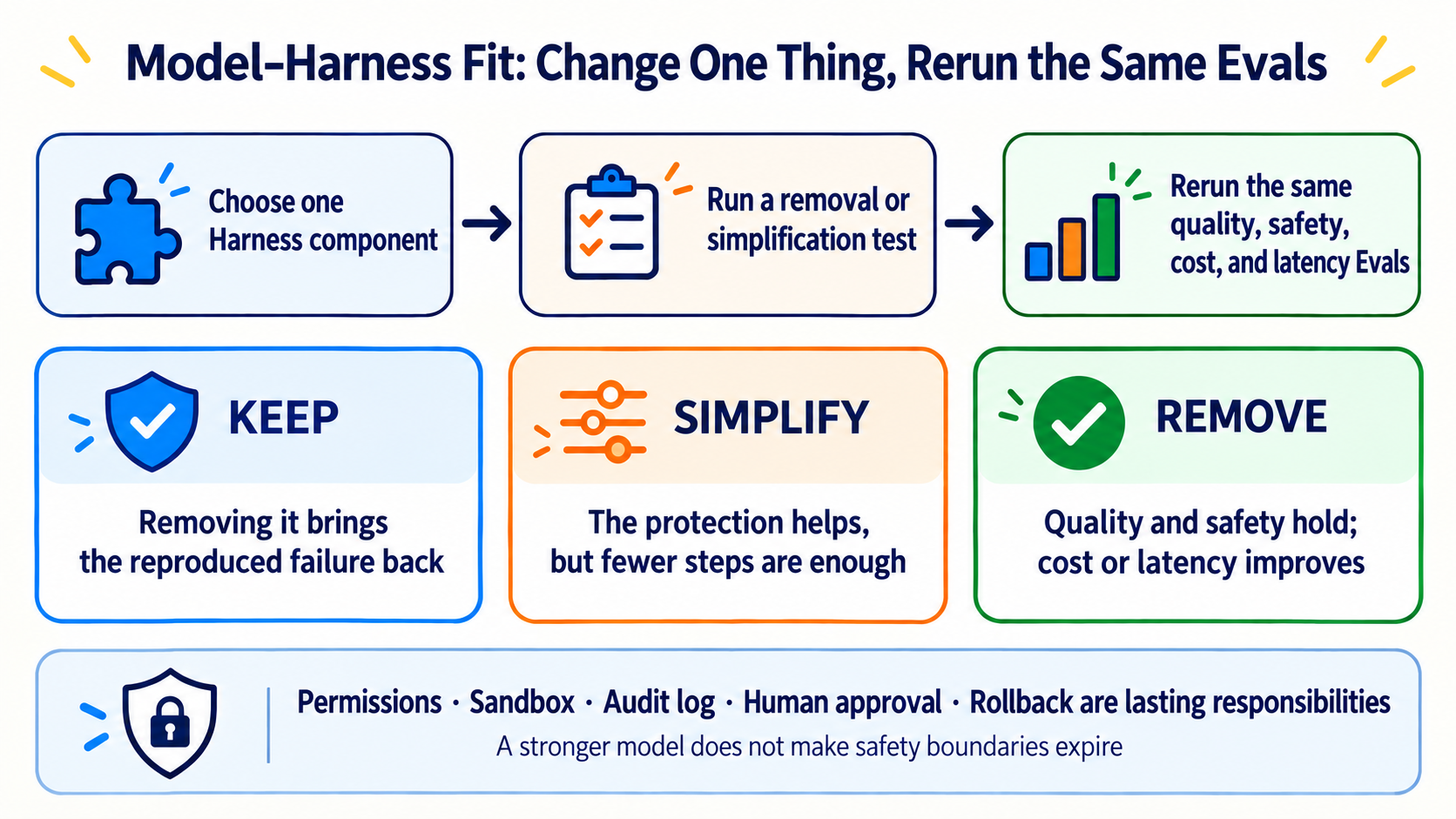
Context Manager (#3) + Eval (#7) are hot spots, hit by 4-5 principles each — which is why v0.2.3 preset / agent-acceptance-gate / agent-shared-memory are all designed around these two components.

Tool Registry (#2) + Observability (#6) are secondary hot spots — hit by 3 principles each. Legibility says "write the schemas right", Invariants says "write the lint right", SoR says "write the logs right".

Retry / Sandbox / Cost-Latency are touched by only 1-2 principles each — these are relatively mechanical components, one main lever per component is enough.

Most of OpenAI's 5 principles have a direct Anthropic counterpart, just under different names. The table below cross-references the two, with canonical URLs for each:

OpenAI principle Anthropic equivalent / pattern Canonical URL
1. Legibility ACI (Agent-Computer Interface) + Tool Documentation Building Effective Agents Appendix
2. System of Record CLAUDE.md hierarchy + Memory persistence Claude Code: How Claude remembers your project + Multi-Agent Research System
3. Progressive Disclosure Same term (Anthropic Skills calls it "the core design principle") Equipping Agents for the Real World with Agent Skills ⭐⭐⭐
4. Taste Invariants Evaluator-optimizer loops + tool "poka-yoke" (e.g. forcing absolute filepaths) Building Effective Agents Evaluator-optimizer
5. Throughput Changes Merge Philosophy "Human evaluation catches what automation misses" + LLM-as-judge in tandem Multi-Agent Research System Evaluation challenges

Three principles Anthropic emphasizes that OpenAI does not feature heavily:

Principle Plain-language meaning URL
Simplicity Start with a basic LLM call; do not jump to multi-step agents Building Effective Agents Simplicity
Transparency "Explicitly showing the agent's planning steps" — the agent reveals its plan Building Effective Agents
Memory persistence Save context to external memory before it fills; spawn subagents with fresh contexts Multi-Agent Research System

Read these 3 first (~45 min total):

  1. Anthropic — Building Effective Agents ⭐⭐⭐ — covers principles #1 + #4 + Simplicity / Transparency. Most foundational, read first.
  2. Anthropic Engineering — Equipping Agents for the Real World with Agent Skills ⭐⭐⭐ — covers principle #3; Anthropic literally uses "progressive disclosure" verbatim, with full 3-tier loading explanation.
  3. Claude Code — How Claude remembers your project ⭐⭐ — covers principle #2; CLAUDE.md 4-tier hierarchy + @-import + AGENTS.md interop.

Then read this one (~20 min):

  1. Anthropic — How we built our multi-agent research system — supplements #2 + #5 + Memory persistence with a production case study.

OpenAI's original article:

  1. OpenAI — Harness Engineering — Codex's own case study; the source of the 5 principles.

📋 Concept-check prompt (self-quiz)

🛠️ Want to actually write SKILL.md / CLAUDE.md now? The 4 implementation prompts (audit existing / generate new) have been moved to Stage 5, which is where readers should do the real hands-on writing: - Stage 5.1 CLAUDE.md design prompts - Stage 5.3 SKILL.md design prompts

This section keeps only one quiz prompt, so you can verify that you actually understand the 5 principles before you start applying them.

Prompt 1 — Self-quiz

I just learned the 5 OpenAI harness engineering principles:
1. Legibility
2. System of Record
3. Progressive Disclosure
4. Taste Invariants
5. Throughput Changes Merge Philosophy

Generate 5 scenario questions. Each describes a realistic SKILL.md / CLAUDE.md design decision (e.g. "I put all examples directly into SKILL.md and it's under 1000 lines"), and asks **which principle is violated + how to fix it**.

Ask one question at a time, wait for my answer, give feedback, then move on. Give a total score at the end.

Suggested usage: run this quiz after learning the 5 principles above to confirm that you actually absorbed the concepts. For the real write / audit prompts, go back to Stage 5.

📐 Advanced agentic application flow (reader guide)

Once you understand the 5 principles above plus the Anthropic cross-mapping, how do you actually apply those ideas in agent design? Starting from Stage 7 (you can already build production agents), 5 steps to production:

  1. Establish the concept-map spine — four work-boundary layers: Types → Config → Repo → Service. Decide which stack layer the agent may touch and when crossing a layer is a violation. → This stage §Concept-map spine: four-layer work boundary

  2. Pick 2-3 relevant advanced concepts: from the 12 skeletons, choose the ones closest to your problem (Work Boundary / Contract / PAR / Autonomy ...). → This stage §12 advanced concepts (pattern list)

  3. Apply the 5 OpenAI principles (cross-cutting): Legibility / SoR / Progressive Disclosure / Taste Invariants / Throughput Merge Philosophy. These 5 cut across all 12 concepts and determine whether the design is "right". → This stage §Cross-concept Harness Engineering principles

  4. Encode into Skills + CLAUDE.md: use the 4 prompts in Stage 5 — CLAUDE.md audit / generate (Stage 5.1) + SKILL.md audit / generate (Stage 5.3).

  5. Verify with an acceptance gate: preset YAML catches drift / LLM-as-judge automates evaluation / human spot-checks cover edge cases. → agent-collab-skills

Production agent ready: stable for real users, auto-verified, predictable failure modes.

How to use these 5 steps: the first time you read this stage, follow 1 → 5 in order. Later, when an agent design gets stuck, come back and identify which step you are actually blocked on.

Difference from the earlier Why → What → How table: that one is a horizontal reference for mapping pain points ↔ principles ↔ tools. These 5 steps are a vertical execution path for what to do after you finish learning.

📖 Complete reading path (layered by depth)

Ordered by depth. You do not need to read everything. The Foundation tier is required (~95 minutes total); everything else is for deeper study when a real problem appears.

🌳 Reading decision tree (pick by the problem you're stuck on)

Agentic AI Advanced Reading Decision Tree

This is not just a reading list. It is a decision tree: identify the problem you have right now, then read the 1-2 papers or posts attached to that branch first. The diagram above shows 5 branches for 5 common stuck-states; below are branch-specific second readings (only after you finish the first one).

Branch-specific second readings:

  • "I don't know how to start with agents" → ReAct paper + Lilian Weng "LLM Powered Autonomous Agents"
  • "Should I use multi-agent at all?" → Anthropic Multi-Agent Research (case study section)
  • "Context feels inefficient" → Anthropic Multi-Agent Research (memory section)
  • "How do I write evals or automate verification?" → Anthropic Multi-Agent Research (eval section)
  • "I want to keep up with frontier work" → AutoGen + ReAct paper

Rule: pick at most 2 deep reads per branch. Finish those, then come back and decide the next branch. Do not broad-scan the whole list first.

Foundation tier (read these 4 first, ~95 min total): - Anthropic — Building Effective Agents - Cognition — Don't Build Multi-Agents - Anthropic — How we built our multi-agent research system - Lilian Weng — LLM Powered Autonomous Agents

Workflow patterns tier: - LangGraph Planning Agents Tutorial - Microsoft AutoGen docs - DSPy

Production / Harness tier: - OpenAI Harness Engineering (2026-02) - Hamel Husain Evals blog - Simon Willison coding agents notes

Frontier research papers (choose 3-5 for deep reading): - ReAct / Reflexion / CoALA / Self-Discover / Voyager / Constitutional AI / AutoGen

Chinese / hands-on: - 李宏毅 GenAI 2024 / 2025 - datawhalechina/hello-agents

📋 After advanced concepts, revisit this synthesisStage 5 §🗺️ 7-Layer Architecture Map (Claude Code's 7 primitives + 3 engineering disciplines in one map)

✅ Self-check

After this stage, you should be able to:

  • [ ] Use the Types → Config → Repo → Service four-layer model to explain why Cognition's Flappy Bird / Anthropic's speculative-leap cases count as work-boundary violations
  • [ ] Name 5 of the 12 advanced concepts, including which layer they touch and a one-sentence definition
  • [ ] Explain the 4 core principle categories (① Context management / ② Interface / ③ Quality verification / ④ Process discipline), what problem each category solves, and the enabling relationships between them
  • [ ] Know which paper / blog to open next, without having to read everything first
  • [ ] Distinguish a PAR loop (single-agent self-correction) from agent-debate (two agents in opposition)
  • [ ] Write the task's work boundary explicitly into a brief (what is in-scope / out-of-scope)

→ If you can do all of these, you are already beyond Stage 7 productionization and into frontier agentic workflow design. What remains is to pick the paper that matches your current pain point and read that one deeply.


→ Next: Stage 8 — Agent Interfaces (a shared hub for both tracks) — learn how agents interact with the non-API world (Computer Use / Browser Use / Code Sandbox). Or pick a specialized branch, or come back and contribute to this repo.