Optional Guide: Model Training and Adaptation
This is a path-selection card, not a training course. It helps you tell which methods change a model and which methods simply help a model do a task. Beginners can read the tables first, then return to Stage 1 to call a ready-made model.
Checked: 2026-08-31 UTC; scope: model training, adaptation, and serving methods.
🧭 See the whole path first
- SFT (Supervised Fine-Tuning): learn by imitating good example answers.
- DPO (Direct Preference Optimization): learn from preferred and rejected answer pairs.
- RLHF (Reinforcement Learning from Human Feedback): use human feedback in reinforcement learning.
- RL (Reinforcement Learning): learn from rewards, which can also come from rules.
RAG (Retrieval-Augmented Generation): retrieve relevant material, then answer using it.
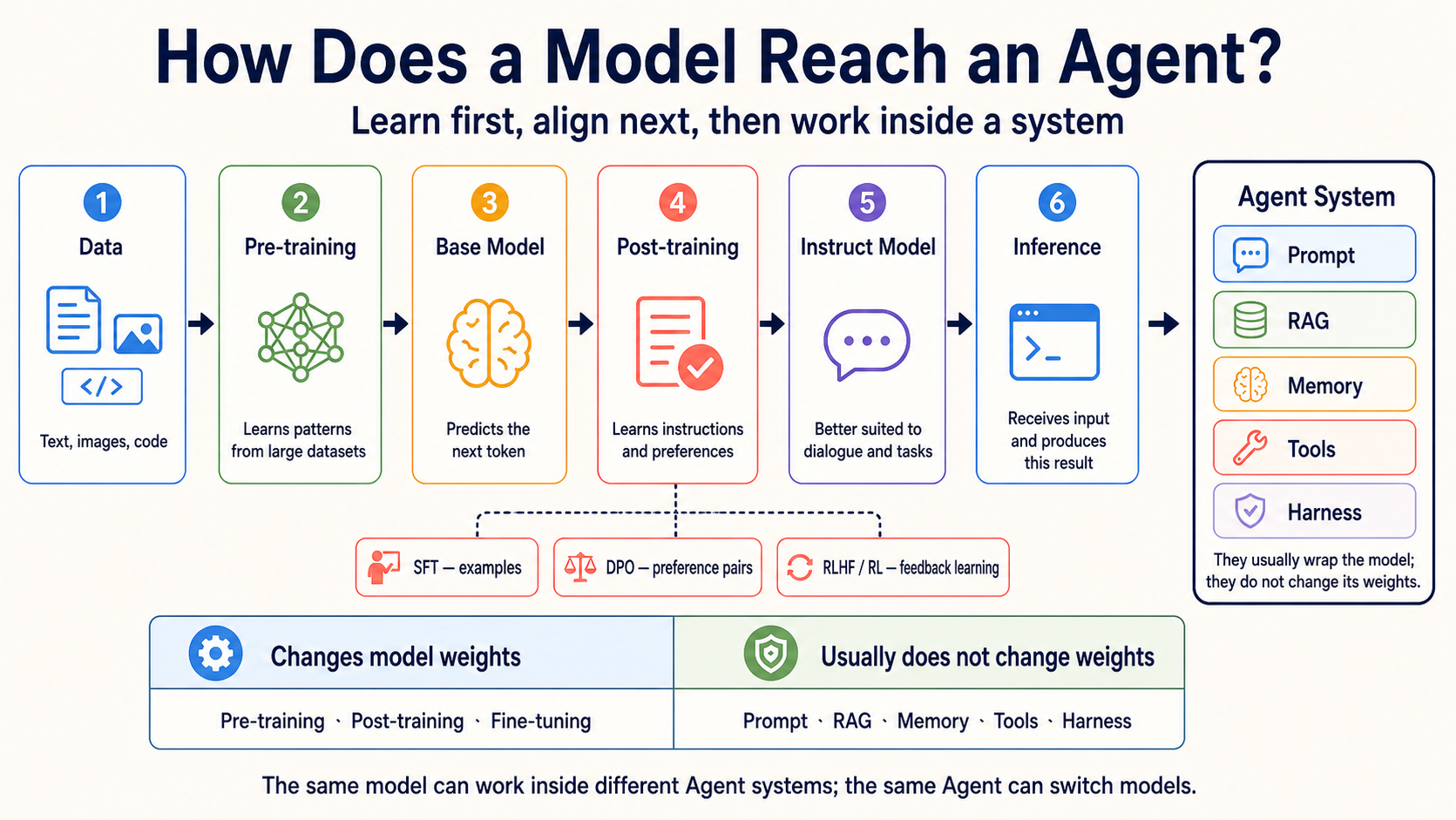
- Pre-training: large amounts of data are used to build a Base Model.
- Post-training: demonstrations, preferences, or feedback teach the model to follow instructions better.
- Inference: after training, the model receives one input and produces one result.
- Agent system: a model is connected to Prompt, RAG, Memory, Tools, and Harness to complete work.
🧩 Learn the methods without implementing them first
| Goal | Method | Plain meaning | Does it change weights? |
|---|---|---|---|
| Teach the model how to act | SFT (Supervised Fine-Tuning) | Show the model good questions and answers so it can imitate them. | Yes |
| DPO (Direct Preference Optimization) | Show two answers and indicate which one is preferred. | Yes | |
| RLHF (Reinforcement Learning from Human Feedback) / RL (Reinforcement Learning) | Use human or rule-based feedback to help the model get better results. | Yes | |
| GRPO (Group Relative Policy Optimization) | Compare several answers to one question, then learn from their relative results. | Yes | |
| Adapt with fewer changes | PEFT (Parameter-Efficient Fine-Tuning) | Train only a small part of the parameters. | Only selected or added parameters |
| LoRA (Low-Rank Adaptation) | Freeze the original weights and train a smaller low-rank matrix. | Original weights no; added parameters yes | |
| Make serving smaller or cheaper | Distillation | Teach a smaller Student Model from a larger Teacher Model. | Trains the Student Model |
| Quantization | Store or compute weights with fewer bits, usually using less memory. | Usually no retraining of the original model; some methods add adjustment |
Do not mistake external systems for training
| Method | What it really does | Usually changes model weights? |
|---|---|---|
| Prompt | Tells the model what to do this time. | No |
| RAG | Finds outside information and puts evidence into this input. | No |
| Memory | Saves state for later and reads it back when needed. | No |
| Tools | Lets a program search, calculate, or take another action after checks. | No |
| Harness | Manages tools, permissions, state, logs, retries, and stop rules. | No |
“Usually no” matters. A product may start a separate training job behind the scenes. Check official documentation for training jobs, trainable parameters, or model weights.
📚 Required reading and selected resources
Read the first two to understand the main path. Use the others when you truly need to train or compress a model. Ratings are editorial guidance, not GitHub stars.
| Group | Resource | Rating | What you learn |
|---|---|---|---|
| Understand the main path | OpenAI: how models are developed | ⭐⭐⭐⭐⭐ | How data, training, and models relate. |
| Google: LLM (Large Language Model, a model that reads and writes language) tuning | ⭐⭐⭐⭐⭐ | The boundary between Prompt Engineering, Fine-tuning, and Distillation. | |
| Learn Post-training | OpenAI: gpt-oss | ⭐⭐⭐⭐ | How one model family describes Pre-training, SFT, and RL. |
| Hugging Face TRL | ⭐⭐⭐⭐ | An entry point for SFT, DPO, GRPO, and other Post-training methods. | |
| Adapt or compress | Hugging Face PEFT | ⭐⭐⭐⭐ | Approaches that train fewer parameters and their limits. |
| Hugging Face LoRA | ⭐⭐⭐⭐ | Freeze original weights and train a low-rank matrix. | |
| Hugging Face Quantization | ⭐⭐⭐ | Use lower precision to reduce memory and compute needs. |
🛠 A decision exercise with no GPU
GPU (Graphics Processing Unit): a processor suited to parallel computation.
Choose a first path for each case and give one reason:
- Company rules change every day: try RAG first.
- Every answer must use a fixed brand voice: start with Prompt and Eval; consider Fine-tuning only if evidence shows it is needed.
- The model is too large for the device: assess Quantization or a smaller model first.
- You want to train fewer parameters for a special format: assess LoRA/PEFT first.
These are not permanent answers. Test with your own data, Eval, hardware, and cost limits.
Advanced: what to check before doing real training
- Do you have permission to use the training data, and have you removed sensitive data?
- Does the Base Model license allow your use and distribution method?
- Are training, validation, and test sets separate?
- Did you keep the unadapted model as a baseline?
- After training, did you rerun safety, bias, quality, cost, and latency Evals?
- Can you stop a failed job, keep a checkpoint, and return to the last usable version?
✅ Completion check
- I can say the order of Pre-training, Post-training, and Inference.
- I know Fine-tuning changes model weights, while RAG usually does not.
- I can explain SFT, DPO, RLHF/RL, and GRPO in one sentence each.
- I know LoRA/PEFT, Distillation, and Quantization solve different problems.
- I will not start an expensive training job just because I saw a new term.