MCP / Skills Integration Catalog
This is a task-based catalog for finding tools when needed, not an install list. Start with an official entry point; expand a category only when the work calls for it.
📌 How to use this catalog
- First state whether you need to read data or write to a real service.
- Prefer official hosted / reference entry points, then check maintenance, licensing, and permissions.
- Start with test data, read-only access, and least privilege. Keep human approval before write, send, or delete actions.
Installation and testing belong in Stage 5; this page only helps you find candidates.
🧩 Five terms to separate first
- MCP Server: a program or hosted service that exposes data or actions as MCP tools.
- Skill: reusable instructions, scripts, templates, and references; loading differs by host.
- Plugin: a host-specific package that may bundle Skills, commands, hooks, or MCP configuration; it is not the MCP specification.
- Remote MCP: an MCP Server operated by a provider, usually using OAuth, so you do not run it locally.
- Permission Boundary: the range an Agent can actually read, write, send, or delete. A tool being capable does not mean every action should run.
📚 Five safe starting points
| Starting point | Learn first | Editorial rating |
|---|---|---|
| Official MCP Registry | Find published MCP Servers; still check the maintainer, permissions, and source | ⭐⭐⭐⭐⭐ |
| modelcontextprotocol/servers | See educational reference implementations; they are not a production recommendation | ⭐⭐⭐⭐⭐ |
| Notion MCP | See how a hosted OAuth MCP follows the user’s workspace permissions | ⭐⭐⭐⭐⭐ |
| GitHub MCP Server | Learn OAuth, tool groups, and repository permissions from an official implementation | ⭐⭐⭐⭐⭐ |
| anthropics/skills | See how Agent Skill folders, instructions, and resources fit together | ⭐⭐⭐⭐⭐ |
⚠️ An MCP Server may touch real data. Even with an official source, confirm the signed-in account, scopes, writable tools, and approval screen.
Index
- Notes / Knowledge Bases
- Office Documents (Word / Excel / PowerPoint / PDF)
- Google Workspace
- Microsoft 365
- Dev Collaboration (GitHub / Atlassian / Slack…)
- Databases
- Browser Automation / Web Scraping
- Design (Figma / Excalidraw)
- Monitoring / Observability
- Media / Streaming (YouTube / Spotify)
- Chinese-language Ecosystem
- Other Common (Cloudflare / Stripe…)
- Research Workflow Skills (Academic / Paper / Literature)
- Multi-LLM Delegation Skills
- Finance / Trading Agents
- Web Search / Retrieval
- Security / MCP Governance
1. Notes / Knowledge Bases
Expand selected entries for category 1
Notion MCP ⭐⭐⭐⭐⭐
| Field | Value |
|---|---|
| Delivery | Notion hosted remote MCP; OAuth |
| Rating | ⭐⭐⭐⭐⭐ (official) |
What it does: Notion’s official hosted MCP can search, read, create, and update content the user can already access.
Audience: People who use Notion for notes, projects, or a wiki and want an MCP-capable client.
Notes: OAuth follows user permissions; review the approval screen before writing. The older open-source makenotion/notion-mcp-server is no longer actively maintained and is not a default for new installs.
MarkusPfundstein/mcp-obsidian ⭐⭐⭐⭐
| Field | Value |
|---|---|
| License | MIT |
| Rating | ⭐⭐⭐⭐ (community maintained) |
What it does: read/write your Obsidian vault via the Obsidian REST API community plugin. Audience: heavy Obsidian users wanting Claude Code to organize daily notes, auto-link, search across files. Notes: requires the Local REST API plugin in Obsidian.
PleasePrompto/notebooklm-skill ⭐⭐⭐⭐
Status (2026-09-10 UTC): archived; the author no longer provides updates or support. Kept as a historical learning example, not a starting point for new workflows.
| Field | Value |
|---|---|
| License | MIT |
| Rating | ⭐⭐⭐⭐ |
What it does: a Claude Code Skill that uses browser automation to query Gemini Notebook (formerly NotebookLM), with citation-backed answers.
Audience: people studying early browser-automation Skill design. For actual use, start with the official website or assess notebooklm-py below yourself.
Notes: requires Google account auth.
teng-lin/notebooklm-py ⭐⭐⭐⭐
| Field | Value |
|---|---|
| License | MIT |
| Rating | ⭐⭐⭐⭐ |
What it does: unofficial Gemini Notebook (formerly NotebookLM) Python API, CLI, and agentic Skill. Audience: people doing programmatic or batch operations in Gemini Notebook (formerly NotebookLM). Notes: unofficial; may break with Google policy changes — check the issue tracker before relying on it.
ergut/mcp-logseq ⭐⭐⭐
| Field | Value |
|---|---|
| License | MIT |
| Rating | ⭐⭐⭐ |
What it does: read/write Logseq graph via Logseq's Local HTTP API. Audience: Logseq users automating daily journals, cross-page links, backlink queries. Notes: enable Logseq's HTTP API (Settings → Features → HTTP API).
skridlevsky/graphthulhu ⭐⭐⭐ (archived / historical example)
| Field | Value |
|---|---|
| License | Previously recorded as MIT; cannot currently reverify |
| Rating | ⭐⭐⭐ (historical rating; no longer publicly accessible) |
What it does: a broad tool set across navigation, search, analysis, writing, journals, flashcards, whiteboards. Audience: people studying early Logseq + Obsidian MCP design; new projects should choose a maintained alternative. Notes (2026-09-10 UTC): the original GitHub address returns 404, so its dead link has been removed. We do not infer deletion, a private repository, or a move. Only the historical name and rating remain, not an available learning resource.
ankimcp/anki-mcp-server ⭐⭐⭐
| Field | Value |
|---|---|
| License | MIT |
| Rating | ⭐⭐⭐ |
What it does: create / query / batch-edit Anki decks via AnkiConnect. Audience: people using Anki for languages / medicine / law — let the LLM auto-generate cards from study material. Notes: requires Anki Desktop + the AnkiConnect addon.
2. Office Documents (Word / Excel / PowerPoint / PDF)
Expand selected entries for category 2
anthropics/skills ⭐⭐⭐⭐⭐
| Field | Value |
|---|---|
| License | No license file (none provided upstream; confirm terms before use) |
| Rating | ⭐⭐⭐⭐⭐ (official examples) |
What it does: Anthropic's official Agent Skills examples include document workflows for docx, xlsx, pptx, and pdf files.
Audience: people who want to study how a standard Skill folder, SKILL.md, scripts, and resources work together.
Notes: this is a Skills collection, not MCP. Preloading, installation, and support differ across Claude / Agent surfaces; check the repository and current host documentation before use.
haris-musa/excel-mcp-server ⭐⭐⭐⭐⭐
| Field | Value |
|---|---|
| License | MIT |
| Rating | ⭐⭐⭐⭐⭐ (community-maintained Excel MCP) |
What it does: Excel file manipulation MCP — read / write / modify cells, formulas, sheets. Audience: people working with Excel reports daily who want LLM-driven data filling and cleanup. Notes: Python-based, depends on openpyxl.
GongRzhe/Office-PowerPoint-MCP-Server ⭐⭐⭐ (⚠️ archived 2025-12; use anthropics/skills pptx)
| Field | Value |
|---|---|
| License | MIT |
| Rating | ⭐⭐⭐ (⚠️ archived) |
What it does: PPT manipulation via python-pptx — create decks, edit slides, insert images, change layouts.
Audience: people who want LLMs to auto-generate decks from outlines / Markdown (consultants, lecturers, students).
Notes: overlaps with anthropics/skills's pptx skill; use this when the official one isn't enough.
open-slide/open-slide ⭐⭐⭐⭐
| Field | Value |
|---|---|
| License | MIT |
| Rating | ⭐⭐⭐⭐ (agent-native slide framework) |
What it does: a React slide framework built for coding agents — describe a deck in natural language and let Claude Code / Codex / Cursor write the React; ships two Claude Code Skills (/create-slide, /slide-authoring).
Audience: people who want agents to produce decks as code (git-versionable) — a different route from PowerPoint-MCP's .pptx output.
Notes: TypeScript / React / Vite; scaffold with npx @open-slide/cli init. It's an agent-native tool (agents author with it), not a Stage 4 agent-building / orchestration framework.
tfriedel/claude-office-skills ⭐⭐⭐
| Field | Value |
|---|---|
| License | NOASSERTION |
| Rating | ⭐⭐⭐ (Office skill add-on) |
What it does: extends anthropics/skills with Office workflows it doesn't cover (automation, advanced formatting).
Audience: people who find the official docx/xlsx/pptx skills too coarse-grained.
Notes: complements anthropics/skills, not a replacement.
xberg-io/xberg ⭐⭐⭐⭐
| Field | Value |
|---|---|
| License | NOASSERTION |
| Rating | ⭐⭐⭐⭐ |
What it does: Rust framework for parsing PDF, Office, image, and other common document formats. Provides an MCP server, REST API, and CLI. Audience: cross-format batch parsing engineers who care about throughput. Notes: covers obscure formats like HWP, ODT, etc., not just PDF / Office.
3. Google Workspace
Expand selected entries for category 3
Google Workspace MCP ⭐⭐⭐⭐
| Field | Value |
|---|---|
| Delivery | Google hosted remote MCP; OAuth 2.0 |
| Rating | ⭐⭐⭐⭐ (official, Developer Preview) |
What it does: Google provides dedicated remote MCP servers for Gmail, Drive, Docs, Sheets, Slides, Calendar, Chat, and People. Audience: people who want an official entry point for reading Workspace data or creating drafts, updating documents, and scheduling meetings. Notes: this is a Developer Preview. OAuth 2.0 and user / organization governance apply; enable only the APIs and scopes the task needs.
taylorwilsdon/google_workspace_mcp ⭐⭐⭐⭐⭐
| Field | Value |
|---|---|
| License | MIT |
| Rating | ⭐⭐⭐⭐⭐ (community-maintained broad Workspace MCP) |
What it does: Gmail, Calendar, Docs, Sheets, Slides, Drive, Chat, Forms, Tasks, Search — all in one MCP server. Audience: people who need community features beyond the official Preview and are willing to maintain the OAuth setup. Notes: community-maintained; broad coverage also means a broader permission surface. Start with read-only access and the smallest useful scope.
xing5/mcp-google-sheets ⭐⭐⭐⭐
| Field | Value |
|---|---|
| License | MIT |
| Rating | ⭐⭐⭐⭐ (Sheets-only) |
What it does: focused Google Sheets / Drive integration — create sheets, edit cells, query formulas.
Audience: people using only Google Sheets who don't want the full Workspace MCP.
Notes: narrower scope than google_workspace_mcp, but simpler setup.
4. Microsoft 365
Expand selected entries for category 4
Softeria/ms-365-mcp-server ⭐⭐⭐⭐
| Field | Value |
|---|---|
| License | MIT |
| Rating | ⭐⭐⭐⭐ (full M365) |
What it does: M365 + Office services via Microsoft Graph API — Outlook, Teams, OneDrive, SharePoint. Audience: enterprise M365 users wanting LLM-driven email replies, calendar lookups, OneDrive operations. Notes: requires Azure AD app registration; corporate IT policies may block this.
ryaker/outlook-mcp ⭐⭐⭐
| Field | Value |
|---|---|
| License | NOASSERTION |
| Rating | ⭐⭐⭐ (Outlook only) |
What it does: Outlook mail / calendar via Graph API.
Audience: people who only need Outlook, not the rest of M365.
Notes: narrower scope than ms-365-mcp-server.
merill/lokka ⭐⭐⭐
| Field | Value |
|---|---|
| License | MIT |
| Rating | ⭐⭐⭐ |
What it does: M365 + Microsoft Graph admin operations — Entra (AD), Intune, etc. Audience: M365 system admins managing tenants / users / policies. Notes: more useful for IT admins than end users.
5. Dev Collaboration (GitHub / Atlassian / Slack…)
Expand selected entries for category 5
github/github-mcp-server ⭐⭐⭐⭐⭐
| Field | Value |
|---|---|
| License | MIT |
| Rating | ⭐⭐⭐⭐⭐ (official) |
What it does: GitHub's official MCP — issues / PRs / repos / Actions / Codespaces. Audience: GitHub users who need to look up repositories, organize issues, or assist with PR review. Notes: prefer OAuth or a least-privilege token. Keep human approval before creating an issue, changing a PR, or triggering a workflow. Track A exercise CLI-9 in A3 uses this entry point.
sooperset/mcp-atlassian ⭐⭐⭐⭐⭐
| Field | Value |
|---|---|
| License | MIT |
| Rating | ⭐⭐⭐⭐⭐ (community-maintained Atlassian MCP) |
What it does: Connects Confluence and Jira through a community MCP server you can self-host. Audience: teams that need self-hosting, custom authentication, or a deployment shape the official remote MCP does not support. Notes: community maintained. Choose this or the official Atlassian remote MCP below after checking company IT policy and permission requirements.
Atlassian Rovo MCP ⭐⭐⭐⭐⭐
| Field | Value |
|---|---|
| Delivery | Atlassian hosted remote MCP; OAuth 2.1 |
| Rating | ⭐⭐⭐⭐⭐ (Atlassian official) |
What it does: Lets an MCP-capable client read and write Jira, Confluence, and Bitbucket Cloud according to user permissions. Audience: teams using Atlassian Cloud. Notes: OAuth 2.1 applies; review approval details before changing issues, pages, or repositories.
Slack MCP Server ⭐⭐⭐⭐⭐
| Field | Value |
|---|---|
| Delivery | Slack official MCP Server |
| Rating | ⭐⭐⭐⭐⭐ (Slack official) |
What it does: Lets an AI app search Slack channels, send messages, manage canvases, and perform other Slack actions. Audience: teams using Slack with an MCP-capable client. Notes: this is not read-only; confirm organization policy and keep human approval before sending or changing content.
Linear MCP ⭐⭐⭐⭐⭐
| Field | Value |
|---|---|
| Delivery | Linear hosted remote MCP; Streamable HTTP |
| Rating | ⭐⭐⭐⭐⭐ (Linear official) |
What it does: Queries or updates Linear issues, projects, and comments. Audience: Linear users who manage sprints or backlogs. Notes: use the official read-only option when needed; writes follow signed-in user permissions.
SaseQ/discord-mcp ⭐⭐⭐
| Field | Value |
|---|---|
| License | MIT |
| Rating | ⭐⭐⭐ |
What it does: Discord MCP — read/write channel messages, manage servers. Audience: maintainers running OSS / community Discord servers. Notes: requires Discord bot token; watch rate limits.
Graphify-Labs/graphify ⭐⭐⭐⭐⭐
| Field | Value |
|---|---|
| License | Apache-2.0 |
| Rating | ⭐⭐⭐⭐⭐ |
What it does: AI coding skill that turns codebases / SQL schemas / R scripts / shell scripts / docs / papers / images / videos into a queryable knowledge graph. Works across Claude Code, Codex, OpenCode, Cursor, Gemini CLI. Audience: engineers / researchers analyzing large codebases, tracking cross-file references, or asking questions across "app code + DB schema + infra" together. Notes: cross-cutting tool — fits both dev collaboration (understanding existing codebases) and research workflow (turning any artifact into a graph). When stuck on a big codebase, use graphify to extract structure, then feed it back to Claude for reasoning.
upstash/context7 ⭐⭐⭐⭐⭐
| Field | Value |
|---|---|
| License | MIT |
| Rating | ⭐⭐⭐⭐⭐ (coding context) |
What it does: Finds documentation snippets by library and version, then puts them into the Agent's current context to reduce the chance of using an old API. Audience: developers who write code across library versions and want to find relevant documentation before editing. Notes: still check the version and original official documentation. It helps find material; it does not guarantee that every result is current or complete.
DeusData/codebase-memory-mcp ⭐⭐⭐⭐⭐
| Field | Value |
|---|---|
| License | MIT |
| Rating | ⭐⭐⭐⭐⭐ (code intelligence) |
What it does: Indexes a codebase into a queryable knowledge graph, so a coding agent can inspect structure, symbols, and call paths before returning to the actual code to verify them. Audience: people running coding agents on large or unfamiliar repos who want fast orientation and lower token use. Notes: re-index after big edits, since the graph can go stale; treat its answers as a fast first pass and verify load-bearing claims (who-calls-X / is-this-dead) against the actual code.
6. Databases
Expand selected entries for category 6
googleapis/mcp-toolbox ⭐⭐⭐⭐⭐
| Field | Value |
|---|---|
| License | Apache-2.0 |
| Rating | ⭐⭐⭐⭐⭐ (Google official, multi-DB) |
What it does: cross-DB MCP server — MySQL / PostgreSQL / Cloud SQL / Spanner / BigQuery. Audience: engineers running databases on Google Cloud, or anyone needing multi-engine support. Notes: open-source + Google-maintained; solid choice for production use.
bytebase/dbhub ⭐⭐⭐⭐⭐
| Field | Value |
|---|---|
| License | MIT |
| Rating | ⭐⭐⭐⭐⭐ (community multi-DB) |
What it does: zero-dependency, token-efficient multi-DB MCP — Postgres, MySQL, SQL Server, MariaDB, SQLite.
Audience: engineers who don't want the Google Cloud SDK and need cross-OSS-DB support.
Notes: overlaps with googleapis/mcp-toolbox but lighter weight.
supabase/mcp ⭐⭐⭐⭐⭐
| Field | Value |
|---|---|
| License | Apache-2.0 |
| Rating | ⭐⭐⭐⭐⭐ (Supabase official-community) |
What it does: connect Supabase (Postgres, Auth, Storage, Edge Functions) to LLMs. Audience: full-stack devs using Supabase as backend. Notes: official community-maintained.
timescale/pg-aiguide ⭐⭐⭐⭐
| Field | Value |
|---|---|
| License | Apache-2.0 |
| Rating | ⭐⭐⭐⭐ (Postgres coding aid) |
What it does: MCP server + Claude plugin to help LLMs write better PostgreSQL code. Audience: Postgres-heavy SQL writers / DBAs. Notes: focused on "LLM writes better SQL", not just query execution.
benborla/mcp-server-mysql ⭐⭐⭐⭐
| Field | Value |
|---|---|
| License | MIT |
| Rating | ⭐⭐⭐⭐ (read-only MySQL) |
What it does: read-only MySQL MCP — let the LLM see schemas, run queries. Audience: scenarios where the LLM should analyze production DBs but never modify them. Notes: read-only is a safety feature, not a limitation.
mongodb-js/mongodb-mcp-server ⭐⭐⭐⭐
| Field | Value |
|---|---|
| License | Apache-2.0 |
| Rating | ⭐⭐⭐⭐ (MongoDB official) |
What it does: MongoDB and MongoDB Atlas Cluster MCP server.
Audience: engineers using MongoDB / Atlas.
Notes: mongodb-js is MongoDB's official GitHub org.
redis/mcp-redis ⭐⭐⭐⭐
| Field | Value |
|---|---|
| License | MIT |
| Rating | ⭐⭐⭐⭐ (Redis official) |
What it does: official Redis MCP — natural-language operations on Redis and Redis Stack (Vector / Search / JSON). Audience: people using Redis as cache / vector DB / queue. Notes: officially maintained; includes vector search.
awslabs/mcp ⭐⭐⭐⭐
| Field | Value |
|---|---|
| License | Apache-2.0 |
| Rating | ⭐⭐⭐⭐ (AWS official) |
What it does: AWS's first-party MCP servers (Lambda / S3 / DynamoDB / CloudWatch / Cost Explorer and more). Audience: teams on AWS who want agents to query / operate their cloud. Notes: officially maintained by AWS; uses your existing AWS login (CLI profiles / IAM roles), no separate token to manage.
7. Browser Automation / Web Scraping
Expand selected entries for category 7
microsoft/playwright-mcp ⭐⭐⭐⭐⭐
| Field | Value |
|---|---|
| License | Apache-2.0 |
| Rating | ⭐⭐⭐⭐⭐ (Microsoft official) |
What it does: Playwright MCP server — let the LLM open browsers, click buttons, fill forms, scrape pages. Audience: anyone doing E2E automation, cross-site integration, scraping behind logins. Notes: Playwright is an official project; evaluate it alongside the browser permissions and login flows your task needs.
ChromeDevTools/chrome-devtools-mcp ⭐⭐⭐⭐⭐
| Field | Value |
|---|---|
| License | Apache-2.0 |
| Rating | ⭐⭐⭐⭐⭐ (Chrome official) |
What it does: expose Chrome DevTools to coding agents — performance, network, console traces all available to the LLM. Audience: developers debugging frontend bugs, doing web performance analysis. Notes: pairs perfectly with Playwright MCP — one drives, one observes.
firecrawl/firecrawl-mcp-server ⭐⭐⭐⭐⭐
| Field | Value |
|---|---|
| License | MIT |
| Rating | ⭐⭐⭐⭐⭐ (Firecrawl official) |
What it does: Firecrawl's official MCP — large-scale web scraping + search + structured extraction. Audience: people scraping large amounts of web data for training / RAG / research. Notes: requires Firecrawl API key (has a free tier).
browserbase/mcp-server-browserbase ⭐⭐⭐⭐ (⚠️ archived)
| Field | Value |
|---|---|
| License | Apache-2.0 |
| Rating | ⭐⭐⭐⭐ (Browserbase official, ⚠️ archived) |
What it does: Browserbase's official MCP, paired with Stagehand for cloud-based browser automation. Audience: people whose local browser automation is too heavy / who need parallel cloud sessions. Notes: commercial service (free tier exists); complementary to Playwright MCP (local vs cloud).
8. Design (Figma / Excalidraw)
Expand selected entries for category 8
Canva MCP ⭐⭐⭐⭐⭐
| Field | Value |
|---|---|
| Delivery | Canva hosted remote MCP; https://mcp.canva.com/mcp |
| Rating | ⭐⭐⭐⭐⭐ (Canva official) |
What it does: Lets an AI assistant create, edit, search, and export Canva designs, and work with assets, brands, and comments. Audience: people who want to operate Canva while following existing design permissions. Notes: each user authenticates; operations follow asset and design permissions, and some features vary by plan. Review high-impact edits before approving them.
GLips/Figma-Context-MCP ⭐⭐⭐⭐⭐
| Field | Value |
|---|---|
| License | MIT |
| Rating | ⭐⭐⭐⭐⭐ (community-maintained design-to-code MCP) |
What it does: feed Figma layout info to coding agents — read design files, expose component structure, let Cursor / Claude Code generate matching React components. Audience: front-end devs going from Figma designs to component code. Notes: requires a Figma access token. Start with a test file and least privilege while checking whether it fits your design-to-code workflow.
excalidraw/excalidraw-mcp ⭐⭐⭐⭐⭐
| Field | Value |
|---|---|
| License | NOASSERTION |
| Rating | ⭐⭐⭐⭐⭐ (Excalidraw official) |
What it does: streamable Excalidraw MCP — let LLMs draw architecture diagrams and flowcharts directly. Audience: anyone writing design docs / system architecture / flowcharts who wants Claude to draw from text. Notes: official Excalidraw; output imports straight into Excalidraw for editing.
yctimlin/mcp_excalidraw ⭐⭐⭐⭐
| Field | Value |
|---|---|
| License | MIT |
| Rating | ⭐⭐⭐⭐ (alternative Excalidraw) |
What it does: MCP server + Claude Code Skill, real-time canvas sync, create / edit / export. Audience: people who need real-time canvas sync and programmatic operation. Notes: complementary to the official; community-maintained.
pbakaus/impeccable ⭐⭐⭐⭐⭐
| Field | Value |
|---|---|
| License | Apache-2.0 |
| Rating | ⭐⭐⭐⭐⭐ |
What it does: "The design language that makes your AI harness better at design." A vocabulary / pattern set that helps AI agents produce UI / visual output that escapes the generic "AI-generated" feel. Audience: developers using AI to generate UI / mockups / visual designs but getting generic results; front-end + AI workflows. Notes: not an MCP server or Skill bundle — it's a design language reference. Feed AI the higher-quality design vocabulary and it produces better output.
9. Monitoring / Observability
Expand selected entries for category 9
grafana/mcp-grafana ⭐⭐⭐⭐⭐
| Field | Value |
|---|---|
| License | Apache-2.0 |
| Rating | ⭐⭐⭐⭐⭐ (Grafana official) |
What it does: Grafana's official MCP — query dashboards / metrics / alerts from the LLM. Audience: SREs / DevOps using Grafana for metrics. Notes: "why did this dashboard line drop?" — ask, and the LLM pulls metrics for the answer.
getsentry/toolkit ⭐⭐⭐⭐
| Field | Value |
|---|---|
| License | NOASSERTION |
| Rating | ⭐⭐⭐⭐ (Sentry official) |
What it does: query Sentry error events / issues / traces from LLMs.
Audience: engineers using Sentry for production errors.
Notes: "show me last week's stack trace for this error" works directly in Claude Code.
The former getsentry/sentry-mcp repository is now getsentry/toolkit, the same project (checked 2026-10-02). Sentry MCP still uses the name sentry-mcp and package @sentry/mcp-server.
winor30/mcp-server-datadog ⭐⭐⭐
| Field | Value |
|---|---|
| License | Apache-2.0 |
| Rating | ⭐⭐⭐ (community Datadog) |
What it does: Datadog API MCP — monitors / logs / metrics. Audience: Datadog users while there's no official Datadog MCP yet. Notes: likely to be replaced once Datadog ships an official MCP.
10. Media / Streaming (YouTube / Spotify)
Expand selected entries for category 10
varunneal/spotify-mcp ⭐⭐⭐⭐
| Field | Value |
|---|---|
| License | MIT |
| Rating | ⭐⭐⭐⭐ |
What it does: connect LLMs to Spotify — play tracks, manage playlists, query history. Audience: anyone integrating playback control or text → music workflows with Claude Code. Notes: requires Spotify Premium (API restriction).
kimtaeyoon83/mcp-server-youtube-transcript ⭐⭐⭐⭐
| Field | Value |
|---|---|
| License | MIT |
| Rating | ⭐⭐⭐⭐ (YouTube transcripts) |
What it does: pull YouTube video transcripts into the LLM for summary / translation / RAG. Audience: people using video as study material, batch-summarizing YouTube content. Notes: depends on YouTube auto-captions; non-English transcripts are hit-or-miss.
ZubeidHendricks/youtube-mcp-server ⭐⭐⭐⭐
| Field | Value |
|---|---|
| License | MIT |
| Rating | ⭐⭐⭐⭐ (full YouTube API) |
What it does: full YouTube API MCP — beyond transcripts, also video management, Shorts, analytics. Audience: YouTube creators automating channel management. Notes: requires YouTube Data API key + OAuth.
11. Chinese-language Ecosystem
Expand selected entries for category 11
leemysw/feishu-docx ⭐⭐⭐
| Field | Value |
|---|---|
| License | MIT |
| Rating | ⭐⭐⭐ |
What it does: bidirectional Feishu (Lark) docs / sheet / bitable ↔ Markdown, with OAuth 2.0, CLI, TUI, Claude Skills. Audience: Chinese-language users on Feishu / Lark wanting to bridge Lark content with Claude Code. Notes: community maintained. Lark APIs, OAuth scopes, and supported features can change; check the current documentation and start in a test space.
netease-youdao/LobsterAI ⭐⭐⭐⭐
| Field | Value |
|---|---|
| License | MIT |
| Rating | ⭐⭐⭐⭐ |
What it does: NetEase Youdao's product-style Agent demonstrates workflow automation, cross-app coordination, and file processing. Audience: people evaluating a Chinese interface and integrations with mainland Chinese services. Notes: this is a complete Agent product, not a Skill or MCP server. Check the current project documentation for supported integrations, permissions, and deployment options.
QwenLM/Qwen-Agent ⭐⭐⭐⭐⭐
| Field | Value |
|---|---|
| License | Apache-2.0 |
| Rating | ⭐⭐⭐⭐⭐ |
What it does: Alibaba's official Qwen agent framework — RAG, tool use, code interpreter, multi-agent, MCP-compatible. Defaults to Qwen models but swappable to other LLMs. Audience: developers using Qwen / Tongyi as primary LLM; teams that want a Chinese-native agent framework (examples + docs are bilingual but Chinese-first). Notes: MCP compatibility and replaceable models are the main teaching points; check current releases, examples, and supported hosts before adopting it.
coze-dev/coze-studio ⭐⭐⭐⭐⭐
| Field | Value |
|---|---|
| License | Apache-2.0 |
| Rating | ⭐⭐⭐⭐⭐ |
What it does: open-source release of ByteDance Coze — no-code agent builder (workflow / plugin / knowledge / memory), self-hosted or cloud. Audience: teams building agents without writing code; engineers wanting a reference implementation of an enterprise agent platform (RAG, workflow, memory, plugin system). Notes: built on Coze's in-house Eino framework; connects to OpenAI / Claude / Qwen / domestic Chinese LLMs. Powers both the international (coze.com) and mainland (coze.cn) products.
coze-dev/coze-loop ⭐⭐⭐⭐
| Field | Value |
|---|---|
| License | Apache-2.0 |
| Rating | ⭐⭐⭐⭐ |
What it does: Coze's agent observability + evaluation platform — trace, debug, eval, prompt management. The back half of the agent dev lifecycle. Audience: teams whose agents are running in production and need monitoring; developers wanting to see how "agent eval / observability" can be designed. Notes: peer to LangSmith / Arize Phoenix; OSS release is self-hostable.
liaokongVFX/LangChain-Chinese-Getting-Started-Guide ⭐⭐⭐⭐
| Field | Value |
|---|---|
| License | unspecified |
| Rating | ⭐⭐⭐⭐ |
What it does: Chinese-language LangChain getting-started guide — covers basics, prompts, memory, agents, chains, and applied examples. It is a structured Chinese learning resource. Audience: Chinese-language users who want LangChain but find the English docs heavy; readers who want to understand LangChain's design before committing to the framework. Notes: no formal license (content is openly readable); LangChain itself moves fast — some APIs in the guide may diverge from the latest version.
chatchat-space/Langchain-Chatchat ⭐⭐⭐⭐
| Field | Value |
|---|---|
| License | Apache-2.0 |
| Rating | ⭐⭐⭐⭐ |
What it does: LangChain-based open-source knowledge-base QA system — local deployment, supports multiple vector stores, end-to-end RAG example. Audience: Chinese teams who want RAG without building it from scratch; scenarios requiring local-only deployment (no cloud LLM). Notes: useful for reading the end-to-end structure of a locally deployed RAG system. Maintenance has slowed; before using it for a new project, check the current branch, dependencies, and issues, and treat it primarily as a reference implementation.
usewhale/whale ⭐⭐⭐
| Field | Value |
|---|---|
| License | MIT |
| Rating | ⭐⭐⭐ |
What it does: Terminal AI coding assistant optimized for DeepSeek models — supports MCP server integration, Claude-style Skills, conversation caching, written in Go. Audience: Chinese developers who use DeepSeek as their primary LLM; those who want a terminal tool without the full Claude Code stack. Notes: One of the few open-source tools with DeepSeek-specific optimization; MCP + Skills dual support allows incremental capability expansion.
simonlin1212/a-stock-data ⭐⭐⭐⭐
| Field | Value |
|---|---|
| License | Apache-2.0 |
| Rating | ⭐⭐⭐⭐ |
What it does: China A-share data Skill that wraps mootdx, EastMoney, akshare, iwencai, and other sources as a data entry point an AI coding assistant can call. Audience: Chinese developers using Claude Code / Codex / OpenClaw for investment research or quantitative analysis; those who don't want to build data-fetching logic from scratch. Notes: community implementation. Data-source terms, stability, and fields can change; verify the original data and licenses before investment research. Check the project's current documentation for compatible hosts.
Looking for WeChat / DingTalk integrations? Today the mainstream is chatbot frameworks (e.g., zhayujie/CowAgent), not pure MCP servers. Will add when proper MCPs emerge.
MoonshotAI/Kimi-K2 ⭐⭐⭐
| Field | Value |
|---|---|
| License | Modified MIT |
| Rating | ⭐⭐⭐ |
What it does: Moonshot's Kimi K2 open-weight LLM series — open weights + OpenAI/Anthropic-compatible API, oriented toward agentic / coding / long-horizon tasks; usable as a backend model for an agent stack. Audience: Chinese developers who want to run agent / coding workflows on a domestic open model, or to self-host open weights. Notes: License is Modified MIT (standard MIT + added large-scale-commercial clauses) — read the original LICENSE before commercial use; weights are also available on Hugging Face.
zai-org/GLM-4.5 ⭐⭐⭐
| Field | Value |
|---|---|
| License | Apache-2.0 |
| Rating | ⭐⭐⭐ |
What it does: Zhipu (Z.ai)'s GLM-4.5 open model — positioned as Agentic, Reasoning, and Coding (ARC) foundation models; open weights + API, usable as a backend for agent / tool use / coding. Audience: Chinese developers evaluating domestic open agentic models, or who need weights under a permissive license (Apache-2.0). Notes: zai-org is Zhipu's open-source org; the same series also has GLM-4 () for context; weights are on Hugging Face.
12. Other Common (Cloudflare / Stripe…)
Expand selected entries for category 12
cloudflare/mcp-server-cloudflare ⭐⭐⭐⭐⭐
| Field | Value |
|---|---|
| License | Apache-2.0 |
| Rating | ⭐⭐⭐⭐⭐ (Cloudflare official) |
What it does: Cloudflare's official MCP — Workers, Pages, R2, KV, D1, DNS, Zero Trust. Audience: anyone running edge / serverless on Cloudflare. Notes: officially maintained; compare its permissions and supported operations with the edge workflows you need.
stripe/ai ⭐⭐⭐⭐
| Field | Value |
|---|---|
| License | MIT |
| Rating | ⭐⭐⭐⭐ (Stripe official) |
What it does: Stripe's official AI agent toolkit, includes an MCP server — handle payments, subscriptions, refunds, customers. Audience: developers wiring payment / billing into agent flows. Notes: ⚠️ this is real money. Test thoroughly in sandbox before going to production.
ComposioHQ/composio ⭐⭐⭐⭐⭐
| Field | Value |
|---|---|
| License | MIT |
| Rating | ⭐⭐⭐⭐⭐ (many tool-integration hub) |
What it does: a platform (SDKs + MCP servers) that connects agents to many apps (Slack / GitHub / Gmail / Salesforce / Notion…) and handles the logins for you, so you don't build a separate connector for each one. Audience: teams whose agents need broad API coverage without maintaining dozens of separate MCP servers. Notes: provides MCP servers + Python / TypeScript SDKs; connect to Claude Code via MCP. A "tool aggregator" (compare with n8n / Zapier for automation).
morluto/jacobian ⭐⭐⭐ (⚠️ submitted by its author)
| Field | Value |
|---|---|
| License | MIT |
| Rating | ⭐⭐⭐ |
What it teaches: a directly installable math MCP server for practicing agent calls to composable, exact computations across polynomial maps, linear algebra, and graph algorithms.
Who it's for: researchers and developers who want to add mathematical computation to MCP workflows or have agents work with structured mathematical problems.
Notes: a Python project, but the launcher ships on npm, which is why it starts with npx. Provides an MCP server, CLI, and Python library. Start with a local MCP configuration and use the native Python API when needed.
How to run:
npx -y jacobian mcp
13. Research Workflow Skills (academic / paper / lit)
Research Skills can organize literature and writing workflows; the researcher remains responsible for citations, source data, and academic integrity.
Expand selected entries for category 13
⚠️ Maintainer's own projects: these are research tools the repo maintainer @WenyuChiou uses and has published. Inclusion is based on the workflow problem solved, not popularity; evaluate them against your research requirements, data, and host.
WenyuChiou/ai-research-skills ⭐⭐⭐⭐⭐
| Field | Value |
|---|---|
| License | MIT |
| Rating | ⭐⭐⭐⭐⭐ (full research workflow) |
What it does: Uses a set of research Skills to cover literature triage, research design, project context, manuscript writing, and multi-AI delegation, distributed through a marketplace. Audience: grad students / postdocs wanting a complete "research workflow" skill set in one drop. Notes: marketplace format, aligns with the plugin/marketplace concept taught in Stage 5.4.
WenyuChiou/academic-writing-skills ⭐⭐⭐
| Field | Value |
|---|---|
| License | MIT |
| Rating | ⭐⭐⭐ (narrow but deep) |
What it does: rigorous academic paper writing / revision / submission skill for Claude Code. Field-agnostic, customizable per-paper via journal_format.md and style_overrides.md. Audience: researchers actively writing / revising papers who want to automate banned-word audit, figure-text coupling, submission checklists. Notes: use it through the complete marketplace, or install it separately by following the current official instructions.
WenyuChiou/zotero-skills ⭐⭐⭐⭐
| Field | Value |
|---|---|
| License | MIT |
| Rating | ⭐⭐⭐⭐ |
What it does: Zotero CLI skill — programmatically search, add, classify, annotate references.
Audience: Zotero users wanting Claude Code to organize their library directly.
Notes: complementary to MuiseDestiny/zotero-gpt — that one is a Zotero plugin (chat inside Zotero), this one is a CLI / Skill (operate Zotero from Claude Code).
WenyuChiou/research-hub ⭐⭐⭐⭐
| Field | Value |
|---|---|
| License | MIT |
| Rating | ⭐⭐⭐⭐ |
What it does: AI-operable research workspace integrating Zotero, Obsidian, and Gemini Notebook (formerly NotebookLM), with several interfaces. Audience: researchers using Zotero, Obsidian, and Gemini Notebook (formerly NotebookLM) together. Notes: complementary to single-tool MCPs (mcp-obsidian, notion-mcp, etc.) — this is a hub that integrates multiple tools.
14. Multi-LLM Delegation Skills
Delegation tools need clear files, budgets, acceptance checks, and stop conditions. A second model does not automatically make an answer correct.
Expand selected entries for category 14
⚠️ Maintainer's own projects: these delegation skills come from the maintainer's daily workflow. Inclusion depends on whether each entry can bound responsibility, inputs, outputs, and acceptance—not popularity. Multi-LLM tools change quickly; evaluate them with the production framework in Stage 7.
How delegation skills compose
The skills below can work together, but each one needs a clear task boundary and acceptance check:
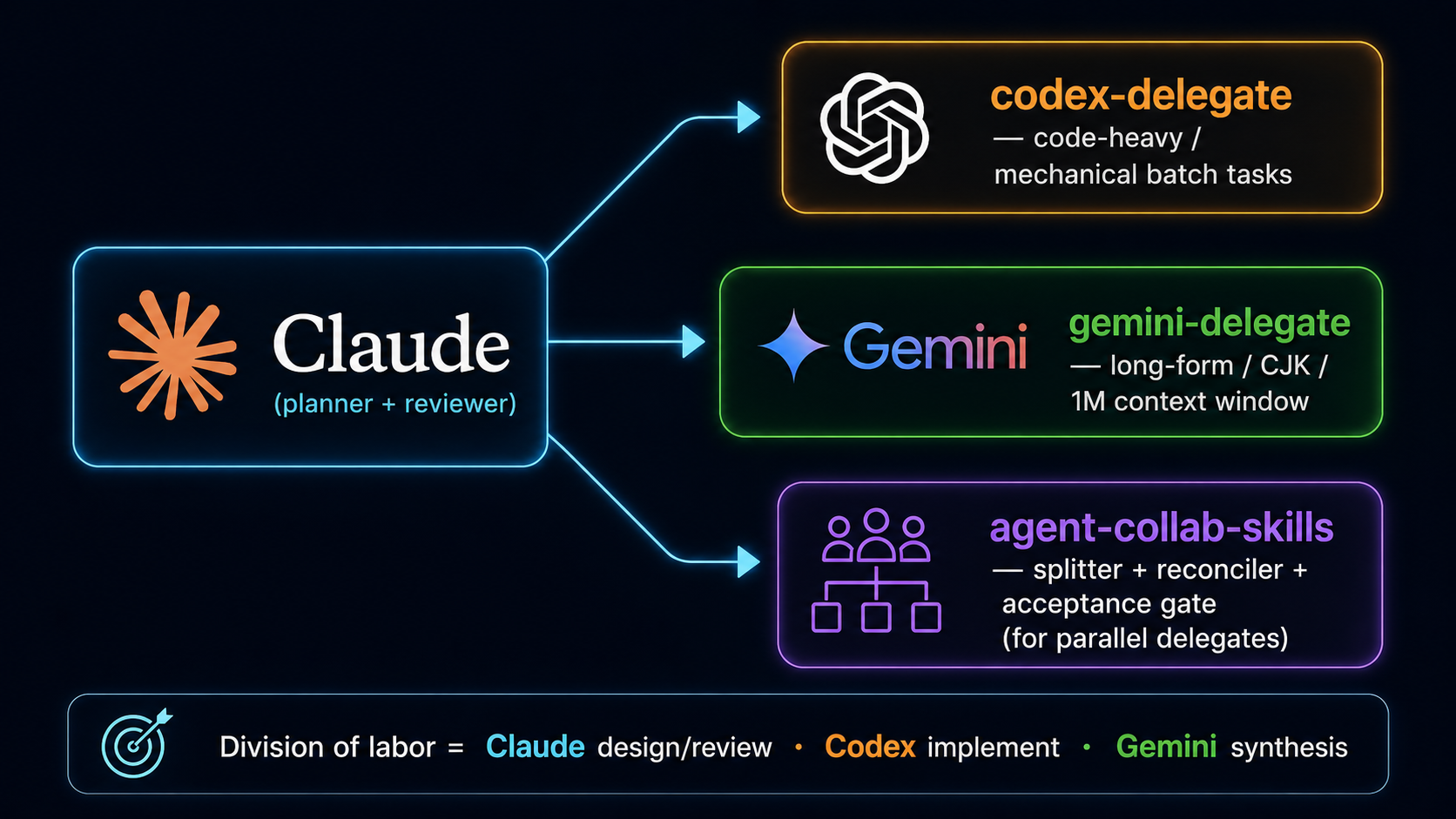
Do not turn model names into permanent job titles. First check the current models, tools, and costs; then assign design / review, implementation, and long-form synthesis to the suitable executors. Use the same acceptance criteria for the final result.
WenyuChiou/codex-delegate ⭐⭐⭐⭐⭐
| Field | Value |
|---|---|
| License | MIT |
| Rating | ⭐⭐⭐⭐⭐ |
What it does: Claude Code skill that uses Codex CLI as the execution specialist — multi-file refactors, batch edits, boilerplate generation, wrapper-based implementation tasks. Claude writes the plan + reviews; Codex executes. Audience: developers wanting to save tokens / accelerate large-scale mechanical edits; learners who want to verify "multi-agent isn't just a buzzword". Use it for: applying one transform across many files, generating test scaffolds, porting an existing pattern, or writing migration scripts. Don't use for: tasks without a clear responsibility boundary or acceptance criteria, or tasks that still need an independent security review. Notes: treat it as a bounded executor, not a permanent job assigned to one model. Validate the result with the same acceptance criteria.
WenyuChiou/gemini-delegate-skill ⭐⭐⭐ (⚠️ archived 2026-07)
| Field | Value |
|---|---|
| License | MIT |
| Rating | ⭐⭐⭐ (⚠️ archived) |
What it does: Historical Claude Code delegation skill that sent long-form, cross-document, or CJK tasks to another CLI executor. Audience: maintainers of older setups and readers studying early multi-LLM delegation patterns. Use it for: history and migration reference only. Don't use for: new work; the repository is archived and is not a current installation starting point. Notes: do not preserve its old fixed model roles. Use a maintained delegation entry that fits the current host and can be checked against explicit acceptance criteria.
WenyuChiou/agent-collab-skills ⭐⭐
| Field | Value |
|---|---|
| License | MIT |
| Rating | ⭐⭐ (experimental — treat as reference) |
What it does: Claude Code marketplace for multi-agent collaboration — task splitter, output reconciler, adversarial debate, shared memory, acceptance gate. Audience: people coordinating multiple delegates who want to see one way of packaging multi-agent coordination into a marketplace. Notes: experimental — don't treat this as a framework ready for production use. It's the maintainer's own setup made public as a reference. For multi-agent frameworks built for production, see LangGraph / Microsoft Agent Framework / CrewAI in Stage 7.
15. Finance / Trading Agents
⚠️ Application-domain section: agents applied to quantitative trading, hedge-fund simulation, and automated order placement. The two entries here are Apache-2.0 and MIT, but licensing across this category varies widely — verify each repo before reuse. Caveat: real-money trading agents carry significant risk; listed here for agent-design study, not as investment advice.
Expand selected entries for category 15
TauricResearch/TradingAgents ⭐⭐⭐
| Field | Value |
|---|---|
| License | Apache-2.0 |
| Rating | ⭐⭐⭐ |
What it does: a multi-agent LLM framework for financial trading decisions, with bull / bear / fundamentals / technicals / risk agents collaborating. Audience: learners studying how multi-agent systems split analytical work; quant researchers experimenting with LLM augmentation of existing pipelines. Notes: Apache-2.0 — modification and commercial use permitted (retain license notice). Not investment advice — do not run on real funds directly.
virattt/ai-hedge-fund ⭐⭐⭐
| Field | Value |
|---|---|
| License | MIT |
| Rating | ⭐⭐⭐ |
What it does: a multi-role AI hedge-fund simulation where bull / bear / fundamentals / technicals / risk agents collaborate to produce trade recommendations. Audience: Stage 7 multi-agent learners wanting a complete application example; people interested in the agent × finance crossover. Notes: MIT-licensed; same caveat as above. Simulation only — not investment advice.
16. Web Search / Retrieval
Expand selected entries for category 16
exa-labs/exa-mcp-server ⭐⭐⭐⭐
| Field | Value |
|---|---|
| License | MIT |
| Rating | ⭐⭐⭐⭐ (Exa official) |
What it does: Exa's official MCP — LLM / agent-oriented web search (neural + keyword) that returns clean results to feed straight into prompts. Audience: people doing research / fact-check / online RAG retrieval — semantic search shines for "concept-related" queries, less so for pure keyword lookups. Notes: requires an Exa API key.
tavily-ai/tavily-mcp ⭐⭐⭐⭐
| Field | Value |
|---|---|
| License | MIT |
| Rating | ⭐⭐⭐⭐ (LLM search MCP) |
What it does: wraps the Tavily search API as MCP, giving an Agent search results and sources. Audience: beginners who want an Agent to search the web and then verify the source content separately. Notes: requires a Tavily API key. Plans and quotas can change; check the current official documentation.
17. Security / MCP Governance
Expand selected entries for category 17
trailofbits/skills ⭐⭐⭐⭐⭐
| Field | Value |
|---|---|
| License | CC-BY-SA-4.0 |
| Rating | ⭐⭐⭐⭐⭐ (official Trail of Bits) |
What it does: the official Claude Code plugin marketplace from security firm Trail of Bits, carrying the skills they use themselves for security analysis, testing, and vulnerability research.
Audience: people who want an agent to help with code audits, vulnerability analysis, and security testing; also anyone curious how a professional security team encodes its own methodology as skills.
Notes: install with /plugin marketplace add trailofbits/skills; Codex supports the same marketplace directly. The license is CC-BY-SA-4.0 (share-alike), so derivative work ships under the same terms; check that before commercial integration. Note this is a different repo from trailofbits/skills-curated in the Stage 5 table: that one is a curation marketplace of community-contributed plugins reviewed by Trail of Bits staff, this one is Trail of Bits' own security skills.
stacklok/toolhive ⭐⭐⭐⭐
| Field | Value |
|---|---|
| License | Apache-2.0 |
| Rating | ⭐⭐⭐⭐ |
What it does: runs every MCP server in an isolated container, replaces local credentials with a minimal permission file, and adds audit logs plus configurable identity and access policy. Ships a Kubernetes operator as well. Audience: teams where everyone has installed their own pile of MCP servers and somebody now has to answer "who installed what, and which credentials can it reach". Notes: Go project, available as a desktop app and a CLI. Open-source ToolHive and Stacklok's enterprise product are separate, so check which features sit on which side.
NVIDIA/OpenShell ⭐⭐⭐⭐
| Field | Value |
|---|---|
| License | Apache-2.0 |
| Rating | ⭐⭐⭐⭐ (NVIDIA official) |
What it does: a sandboxed execution environment for autonomous agents, with declarative policy over files, network and processes. Claude Code and Codex run inside it unmodified; OpenClaw goes through NemoClaw, the next entry below.
Audience: people who want an agent to actually execute commands without handing it the whole machine.
Notes: Rust project. Needs Docker / Podman or host virtualization for MicroVM-backed sandboxes; Windows goes through WSL 2 and is marked experimental. ⚠️ The project still calls itself alpha, so read it and try it, but assess before depending on it. The split against toolhive: toolhive governs MCP servers, this governs the Agent's own execution boundary.
nolabs-ai/nono ⭐⭐⭐⭐
| Field | Value |
|---|---|
| License | Apache-2.0 |
| Rating | ⭐⭐⭐⭐ |
What it does: confines agents using the operating system's own isolation (Linux Landlock, macOS Seatbelt), with no daemon and no container. Audience: people who want a sandbox without installing a whole container runtime for it. Notes: Rust project, maintained by the team behind Sigstore. Going container-free is the main trade against OpenShell: faster to start, but the isolation is only as strong as what the OS provides.
What's not here?
If your integration isn't above, check these catalogs first:
- Official MCP Registry — find published MCP servers, then check the maintainer, permissions, license, and current status
wong2/awesome-mcp-servers— community MCP server catalog with many entries by categorypunkpeye/awesome-mcp-servers— another MCP server catalog, complementarymodelcontextprotocol/servers— official reference implementations for learning how MCP works; not production recommendation material.travisvn/awesome-claude-skills— Claude Skills catalog
Want to add something?
- Open an issue with the repo link, why it should be added, and which category it fits.
- Or open a PR with its source, license or service status, editorial rating, purpose, audience, permissions, and limits.
- Explain which learning gap it fills; popularity numbers alone do not prove quality or safety.
Read resources/style-guide.en.md and CONTRIBUTING.en.md before submitting.
Notes for anyone helping out later
Not an SLA — just "do what you can" guidance:
- Treat vendor documentation or the canonical repo as the source for official status, licensing, permissions, and hosted endpoints.
- CI periodically scans repository redirects, archive status, HTTP errors, and freshness signals. A warning still needs human judgment; do not remove a stable tool only because it has not released recently.
- Define the reader's task and safety boundary before opening a new category, then add verifiable official or high-quality community entries.
- Apply the same rule to Chinese-community tools: a newly added third-party GitHub repo needs at least 1,000 stars, plus checks for learning value, maintenance, licensing, and permissions. Official documentation, standards, and irreplaceable canonical sources are exempt.
- Make wording and formatting clear enough for a five-year-old to follow while preserving exact terms, limits, and sources.